
Daraa – Mahjoub al-Hashish
In a shelter center for displaced people in the town of Eastern Maliha, eastern rural Daraa, Hussein al-Hammoud sits with dozens of displaced persons on a school bench at the center’s entrance, lamenting the situation of the Bedouins of Jabal al-Arab after their displacement from As-Suwayda following the bloody events that unfolded in the area.
After recounting what happened to him during the events in Suwayda, Hussein asks, “Who will compensate me for my loss?”
Hussein al-Hammoud estimated his loss at nearly one billion Syrian pounds, approximately 100,000 US dollars (with the dollar at around 10,000 SYP), having lost two residential apartments that were burned, a tractor, 200 sheep, and a motorcycle.
Hussein said he left with his family wearing only their clothes and took none of their belongings, adding that he had built his wealth through hard work, working three shifts a day until he was able to build a house for himself and his son and purchase livestock.
Hammoud al-Barjas, who resides in the same center, told Enab Baladi that he lost a farming project consisting of about 20 dunums of tomatoes (one dunum equals 1,000 square meters) which had reached the harvesting stage, and he also left 200 sheep at his home.
The price of a single sheep is estimated at around two million Syrian pounds (roughly 200 dollars), and Hammoud expects his property to be confiscated and his crop destroyed, as it requires daily care—watering, pesticide spraying, harvesting, and other agricultural tasks.
Hamad al-Hammoud said he has debts in the “al-Hal Market” in Suwayda amounting to 50 million Syrian pounds (around 5,000 dollars), and he also lost 50 sheep, an agricultural vehicle, and a motorcycle.
Clashes erupted between Bedouin tribes and local factions belonging to the Druze community following the abduction of a driver and an agricultural vehicle on July 12, which escalated to the intervention of the Ministries of Defense and Interior, followed by confrontations with factions after reports of violations committed by government forces against members of the Druze community.
Government forces withdrew after a public Israeli intervention in support of the local factions, which included shelling government convoys around Suwayda and bombing the General Staff building in the capital, Damascus, on July 16.
After the government’s withdrawal, members of the Bedouin tribes were subjected to violations, executions, and property burnings, prompting intervention from tribes across various Syrian governorates.
Clashes took place between the tribes and local factions loyal to the spiritual leader of the Druze community, Sheikh Hikmat al-Hijri, led by the “Military Council in Suwayda.”
The pace of the clashes subsided following the intervention of the Internal Security Forces of the Ministry of Interior, which encircled the administrative borders between Daraa and Suwayda and implemented a ceasefire under international sponsorship.
The Syrian Network for Human Rights documented the killing of no fewer than 814 people and the injury of 903 others in the Suwayda events between July 13 and 24.
The Network’s tally includes civilian casualties, including children, women, and medical personnel, in addition to fighters from armed Bedouin tribal groups and local groups from the governorate, along with personnel from the Internal Security Forces and the Ministry of Defense.
Ongoing “Forced Displacement”
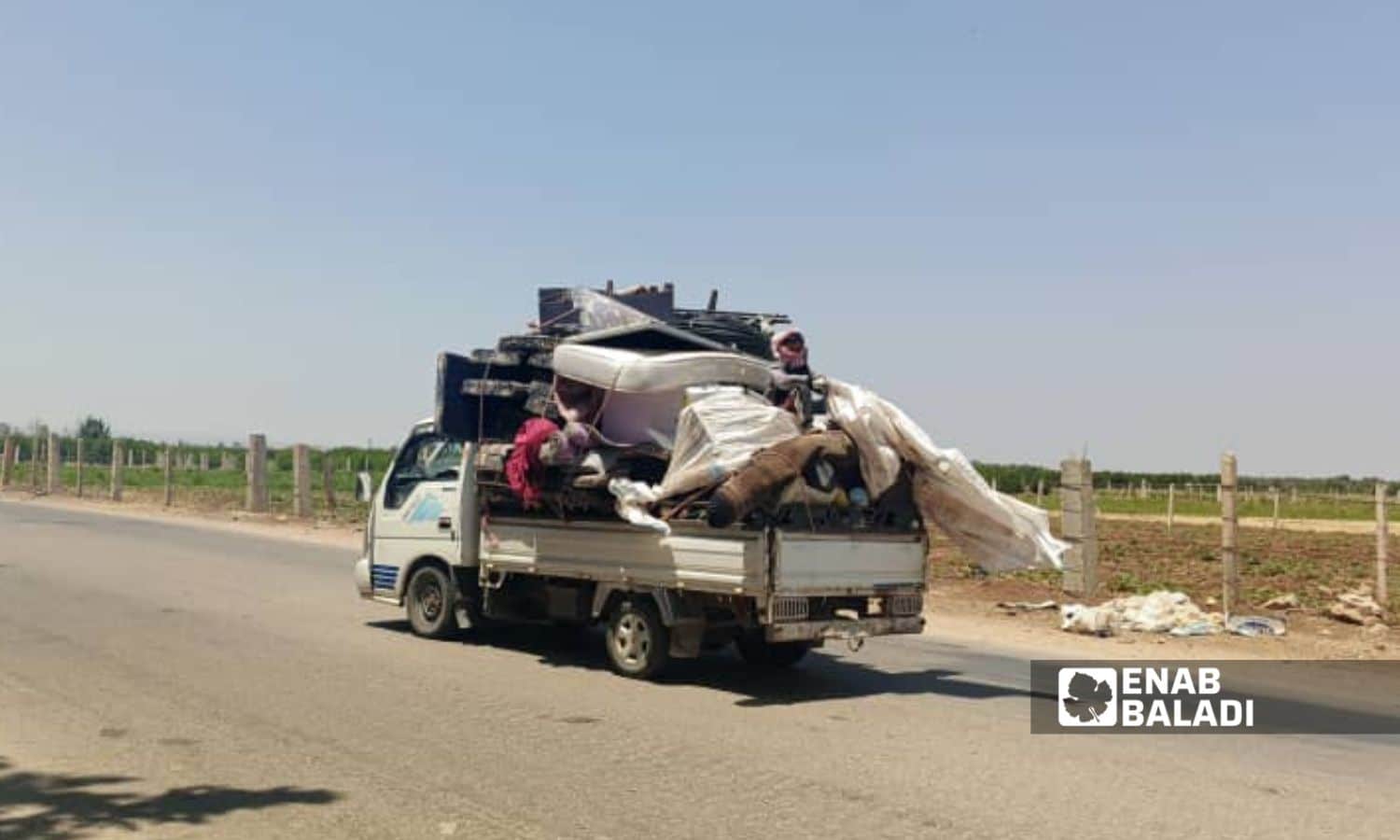
Convoys of displaced persons from the Bedouin tribes continue to leave areas controlled by local factions in Suwayda, in implementation of a provision in the ceasefire agreement.
While the Syrian government claims the Bedouins have left Suwayda temporarily due to the security situation in the governorate, legal experts and activists consider what is happening to be tribal displacement.
The director of the Syrian Network for Human Rights, Fadel Abdul Ghany, told Enab Baladi in a previous report that the transportation of Bedouin families from Suwayda, in legal terms, constitutes forced displacement because it is one-way with no return—unless the government demonstrates otherwise through action.
Abdul Ghany added that these individuals left against their will, in one direction. They have lived in the region for hundreds of years, with homes, property, businesses, and daily and commercial relationships, making it necessary for the Syrian government to clarify the terms of the agreement under which these families are being displaced.
Who Will Compensate Them?
Opinions among legal professionals in Daraa governorate in southern Syria vary regarding how to compensate the Bedouins for their civilian losses in Suwayda and which party is responsible for this compensation.
Lawyer and violations documentation activist Assem al-Zoubi told Enab Baladi that the Syrian government is responsible for compensating those affected by the events in Suwayda, whether Bedouins or Druze, since the events occurred within its geographic domain, noting that Suwayda is part of the Syrian state.
As for international organizations, al-Zoubi said they do not offer individual compensation but rather provide humanitarian, medical, and food assistance.
For his part, lawyer Burhan al-Shaabin stated that the issue is more complex than directly seeking compensation. First, it must be determined whether the displacement is permanent or temporary.
This depends on the government’s ability to reassert control over the governorate. After this determination, an independent fact-finding committee should be formed to investigate and document violations and losses, after which the issue of compensation can be addressed.
Responsibility of the “Military Council”
Hammoud al-Barjas, one of the displaced Bedouin residents from rural Suwayda, said he would not return to his home until the state regains full control of the governorate and disarms the “Military Council in Suwayda.”
Lawyer Tarek al-Khalil, a member of the Human Rights Committee at the Daraa Bar Association, argued that under the general legal principle, the responsibility for compensation lies with the direct cause.
In this case, he said, responsibility falls on the “Military Council in Suwayda” for civilian property and the “crimes” committed against them.
He believes that violations and losses should be documented, after which legal action can be pursued.
Al-Khalil noted that the legal process becomes clear once the nature of the displacement is determined and the violations and damages are documented.
He also stated that the Bar Association may volunteer to defend those affected.
Al-Khalil connected Israel’s involvement in the matter with the cases filed against it in the International Court of Justice, saying it is possible to file lawsuits against the “Military Council” as one of the “arms of the Israeli entity,” in his words.
The post Bedouins of Suwayda Lose Their Property… Who Will Compensate Them? appeared first on Enab Baladi.