
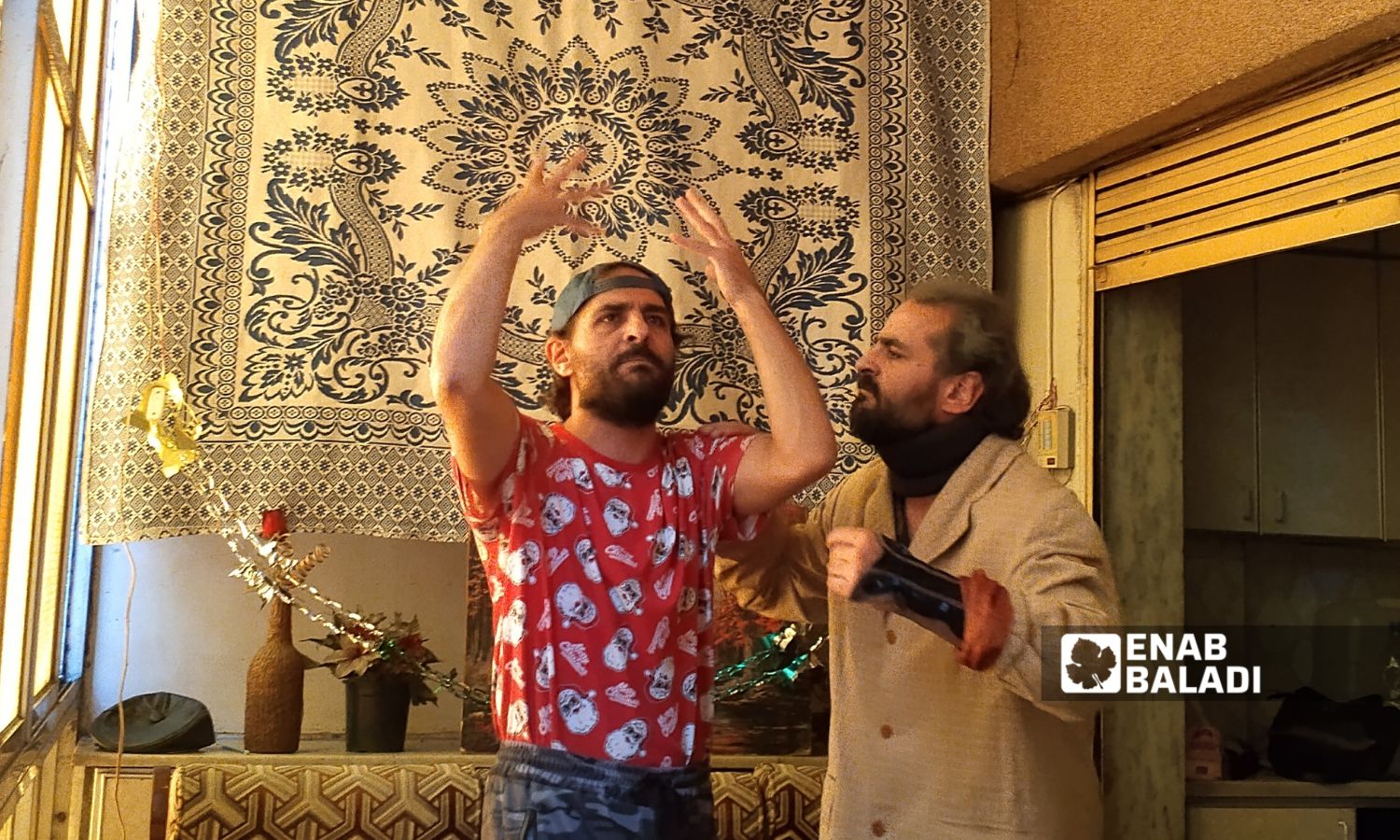
Enab Baladi– Amir Huquq
Theater, often referred to as the “father of all arts,” is a symbol of culture and life—a space for ideas and a mirror of the society it reflects with honesty and creativity. It is one of the oldest art forms known to humanity.
In Syria, theater holds a special place as a cultural and artistic platform that captures the pulse of society. Theatrical productions have historically tackled a wide range of topics, from social and humanitarian issues to political themes and beyond.
Syrian Theater in a State of Clinical Death
Syria’s theater scene today is witnessing a subdued reality compared to other countries, marked by a noticeable decline in the number of productions, the closure of several theaters, and a lack of private sector support for the performing arts.
Speaking to Enab Baladi, director and instructor at the Higher Institute of Dramatic Arts, Maamoun al-Khatib, described the current state of Syrian theater as “clinical death.” He attributes this to neglect, society’s diminishing view of theater as a civil art form, and an overall undervaluing of culture.
Multiple factors have contributed to this decline, al-Khatib explained, including the collapse of cultural infrastructure, the disintegration of the state’s role in cultural production, and the emigration of leading directors, actors, and playwrights—especially those with independent or experimental voices. He also noted a waning public interest, as basic survival, security, and livelihood have become people’s priorities, severing their connection to theater.
In addition, the dominance of commercial television drama as a source of income and fame has made theater seem like a losing luxury. The absence of critical and academic support from universities and cultural institutions has further hollowed out theatrical discourse.
Launching Support Funds
Syrian theater today faces a set of urgent needs and priorities that, if addressed, could help revive its productivity and restore the vibrant stage presence it once enjoyed.
According to theater director and instructor at the Higher Institute of Dramatic Arts, Maamoun al-Khatib, the most pressing requirement is the development of a national cultural strategy that treats theater as a tool for public awareness and social development—not merely as ceremonial entertainment.
He emphasized the importance of launching independent production funds free from political censorship, to support new scripts and emerging talents. He also called for technical upgrades to theater venues—including sound systems, lighting, and equipment—to transform them into professional spaces rather than deteriorating stages.
Al-Khatib added that Syrian theater must be integrated into schools and universities and extended into rural areas and suburbs through the creation of community theaters. He also stressed the need to grant artists expressive freedom to critically engage with reality without fear or censorship.
From Censorship to Cultural Partnership
For decades, Syrian theater artists have suffered from government neglect. Al-Khatib argued that the state must shift from a censoring authority to a cultural partner—supporting theater as a space for critical thought rather than treating it as a political threat. He called for transparent production grants, especially for performances outside the capital.
Although nominal freedoms may exist, self-censorship and collective fear continue to dominate. Al-Khatib said that censorship goes beyond script deletions to include psychological and systemic barriers that limit artistic ambition.
He advocated for transforming the censorship committee into an evaluative board focused on encouraging dialogue and constructive critique. Repressive oversight should be abolished, replaced by thoughtful guidance centered on artistic quality and societal relevance.
Respecting Syrian Theater’s Rich History
Today, many renowned Syrian actors avoid the stage due to its demanding rehearsals—sometimes lasting months—and minimal compensation that often doesn’t even cover transportation costs.
Al-Khatib said this grim reality reflects a painful truth: “Artists need to survive. They deserve decent wages. Syrian theater offers nothing but exhaustion and disappointment, while television offers money—regardless of content.”
He called for a professional theater production environment that respects art and artists—through fair pay, engaged audiences, creative freedom, social appreciation, and cultural leadership.
According to al-Khatib, what Syrian theater needs is not superficial reform but a foundational rebuilding effort: institutionally, artistically, ethically, and culturally.
“It requires a cultural revolution, not cosmetic change,” he said, “and respect for real talent and Syria’s historic theatrical legacy.”
In a previous interview with Enab Baladi, playwright and actor Ghazwan al-Ballh called for lifting restrictions on theatrical texts, especially in light of the relative freedoms of today. He noted that current censorship practices remain largely unchanged from the era of the previous regime.
Despite challenges, recent productions include “Souq al-As’ila” (Market of Questions) by al-Ballh, directed by Mohammad Hamira and performed at al-Qabbani Theater, and “Kul ‘Aar Wa Antum Bikhayr” (Every Shame and Happy Holidays to You) by the Malas brothers at their independent venue “al-Ghurfa” (The Room).
The post Flatlining on Stage: Syrian Theater Suffers from Lack of Freedom and Support appeared first on Enab Baladi.