
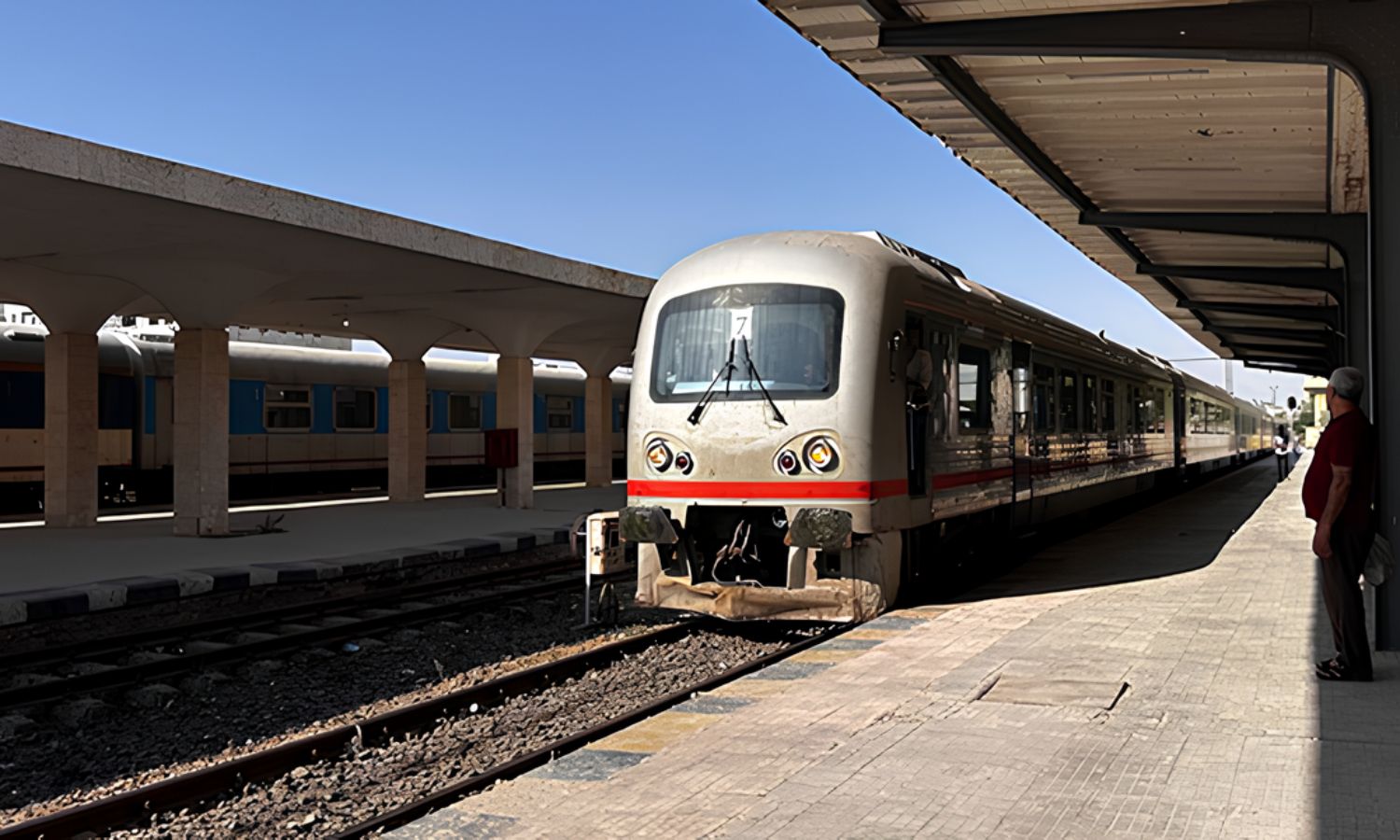
The Train Sit train group launched,6 August the first trial journey of the train linking the cities of Aleppo and Hama, after it had been suspended for more than 13 years due to the war.
The head of the Train Sit group, Mohammad Hamza Abaram, told the Syrian Arab News Agency (SANA) that this journey is the “result of comprehensive maintenance operations that affected both the trains and the tracks,” considering it a “major achievement” following years of inactivity.
He noted that the ambitions do not stop at Hama Station, but include the full restoration of the railway network across Syria, with plans to link it to the Turkish railway network via Gaziantep.
The train, which covers the distance between Aleppo and Hama at speeds up to 160 km/h, is equipped with air-conditioning systems and service amenities, including an onboard refreshment area.
Abaram pointed out real challenges hampering expansion, foremost among them the shortage of qualified technical personnel and spare parts necessary for fleet maintenance, calling for urgent support to ensure the project’s continuity and expansion.
On his part, the deputy head of the center in Aleppo, Mohammad Khair Abdul-Salam, told SANA that the Train Sit workshops have spent the past three months rehabilitating the halted trains, alongside repairing the electrical and mechanical infrastructure of the line, and preparing railway lines in several governorates.
Abdul-Salam stated that the Aleppo–Hama line is just the beginning, and the next step will be the operation of the Aleppo–Homs line, which will extend to Damascus and Latakia, with plans to connect the network to the eastern region and Turkey.
Railway Losses
The railway line between Aleppo and Hama was suspended in 2012, with the intensification of military operations and the expansion of clashes in Syria’s central and northern regions, which led to the disconnection of several vital transport lines from service—among them the Aleppo–Hama line, which played a central role in transporting passengers and goods between the north and south.
The line passes through areas that witnessed intense battles, such as Khitab town in Hama, Abu al-Dhuhur in Idlib, and Mushrifa al-Marij village in Aleppo, and it suffered extensive damage that included destruction of portions of the track, sabotage of stations and control centers, as well as looting of carriages and maintenance warehouses.
Moreover, the complexities of the security situation and the inability to access maintenance and repair sites led to its near-complete isolation from the rest of the network.
According to government reports and official statements from previous years, the line’s suspension was not only due to technical breakdowns, but also the loss of administrative and technical control over wide stretches of its route—especially in rural areas of Hama and Idlib, which were out of control of the former Syrian regime for long periods.
Railway lines in Syria have sustained damages amounting to approximately USD 1.5 billion since 2011, and the damage to track infrastructure in Aleppo Governorate accounted for 55 percent of the value of these damages, according to SANA.
Despite repeated official statements about intentions to reactivate some lines, the Aleppo–Hama line remained out of service for more than 13 years.
The total length of Syria’s railway network is approximately 2,500 kilometers. The institution is involved in transporting fuel to power plants, grains to and from silos, as well as gas and oil derivatives, and containers from Syrian seaports to dry ports, in addition to passenger transport between most governorates and cities.
The post After 13 Years of Suspension… The Aleppo–Hama Train Returns to Service appeared first on Enab Baladi.