
Enab Baladi – Sedra al-Hariri
Syria has never faced a heavier debt burden in its modern history than over the past decade, as war deepened, domestic production collapsed, and the economy crumbled.
According to a World Bank report published in June 2024, Syria’s external debt reached around $22.3 billion, equivalent to 104% of GDP. Of this, nearly $1.2 billion is owed to Russia, with no arrears recorded. Iran tops the list of creditors with about $17 billion, accounting for more than four-fifths of Syria’s total arrears.
While Russia’s share appears modest compared to Iran, Moscow has long wielded this file as a lever of political and economic influence, ensuring its foothold in Syria.
For decades, Russia stood as Damascus’ most reliable ally, providing military and diplomatic cover as well as economic lifelines, from wheat shipments to soft loans and barter arrangements.
A Legacy of Debt and Conditional Deals
Syrian debts to Moscow date back to the 1970s. By 2005, they had swelled to $13.4 billion. That year, Russia agreed to write off about 73% of the sum in exchange for access to strategic projects in Syria.
Damascus committed to repaying $1.5 billion in installments over ten years, while an additional $2.1 billion was settled through barter contracts in oil, gas, and telecommunications.
Thus, debt evolved into a political and economic instrument, offering Russian companies a privileged entry into the Syrian market.
Cash Transfers Amid War and Sanctions
Beyond official loans, the Financial Times revealed that Syria’s Central Bank shipped more than $250 million in cash to Russia between 2018 and 2019—a peak period of Moscow’s military intervention.
Over 20 flights carried the money to sanctioned Russian banks, interpreted by experts as partial repayments or direct payment for military support.
Debt as a Political Lever
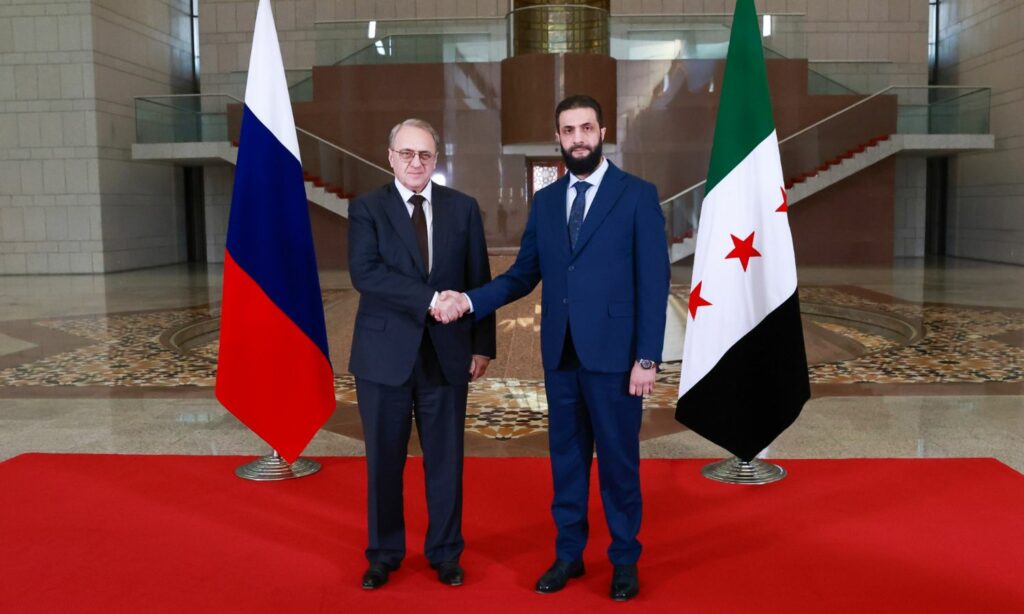
Today, Russian debt has resurfaced as a negotiation file. Transitional Syrian President Ahmad al-Sharaa recently met Russian Deputy Foreign Minister Mikhail Bogdanov in Damascus to discuss the possibility of writing off part of the debts inherited from Bashar al-Assad’s rule.
Meanwhile, former Syrian Finance Minister Mohammed Abazid estimated the country’s external debt at between $20 and $23 billion, without specifying Russia’s exact share, during an interview with Al Jazeera Mubasher.
Reshaping Influence
Moscow appears less interested in financial recovery than in leveraging debt to guarantee its long-term military, political, and economic presence in Syria.
Dmitry Bridghe, an expert with the Russian International Affairs Council, told Enab Baladi that debt has shifted from a static financial matter into a strategic tool for consolidating Russia’s foothold.
According to him, Russia now synchronizes debt settlements and restructuring with broader influence-building steps across contracts, ports, and military bases.
Bridghe identified three main categories of Syria’s debt to Russia:
-
Arms and military services
-
Sovereign loans and budgetary support
-
Secured investment contracts in energy, phosphates, and ports
Military debts, in particular, are not just numbers on paper but bargaining chips in exchange for strategic gains, chief among them securing Russia’s military bases and long-term economic concessions.
Military Bases: Assets Beyond Debt
Russia’s ties with Syria extend far beyond financial obligations. Its two main military bases, Hmeimim airbase in Latakia and Tartus naval facility on the Mediterranean, were established under long-term agreements with the Assad regime, becoming entrenched assets outside the debt file.
Hmeimim hosts runways, intelligence centers, and advanced defense systems, while Tartus secures Russia’s first-ever Mediterranean naval foothold.
Bridghe stressed that these bases are “non-negotiable pillars” in any talks. Any Russian concession on debt would be conditioned on guarantees securing continued military access and exclusive rights in select sectors of the Syrian economy.
“Moscow will not write off debt without a clear strategic quid pro quo, backed by ratified treaties and international arbitration mechanisms,” he said.
At the same time, the transitional government in Damascus, now engaging with Washington and Europe, is expected to resist granting privileges that compromise sovereignty, turning the debt file into a contest of wills.
“Odious Debt”: Between Law and Politics
International law recognizes the doctrine of “odious debt,” which holds that loans incurred by despotic regimes for oppressive or harmful purposes are illegitimate and not binding on successor governments.
This principle was applied in Iraq after 2003, when much of Saddam Hussein’s debt was canceled, and in several African states after decolonization.
Applied to Syria, legal and economic experts argue that loans tied to Russian or Iranian arms purchases or coercive wartime deals could be classified as odious, since they served repression rather than development.
Strategic Contracts as a Constraint
According to political economy researcher Soqrat al-Alou, the complication lies in the intertwining of debt with long-term strategic contracts, such as Tartus port management rights and phosphate mining concessions.
This overlap makes financial negotiations inseparable from broader political and economic interests.
Al-Alou noted that Damascus’ bargaining power depends partly on its ability to review or annul contracts based on Russian non-compliance, as seen recently in the cancellation of the Tartus commercial port contract.
Yet Moscow may counter with debt relief offers in exchange for fresh concessions, placing Damascus in a difficult negotiating position.
Legal Avenues and Options
Legally, Syria could invoke the “odious debt” doctrine to argue that certain loans served oppressive ends. However, al-Alou explained that this principle is not binding internationally and would require political agreements with creditors. Otherwise, disputes may end up in arbitration courts.
Even if debt is forgiven, the contracts remain enforceable unless terminated under their own terms or Syrian law, necessitating a case-by-case review.
Al-Alou outlined three plausible scenarios:
-
Partial debt write-off in exchange for economic or political concessions.
-
Temporary suspension of repayments until a comprehensive settlement is reached.
-
Continued Russian leverage, linking debt settlements to sensitive issues such as military bases and natural resource shares.
International Constraints
Al-Alou further noted that international financial support for Syria remains limited, despite the World Bank’s re-engagement after clearing arrears. Donor institutions condition assistance on ensuring that reconstruction funds are not diverted to settle political claims with Russia.
Meanwhile, proposals to pay off debt from the Assad family assets in Russia face obstacles. Evidence of recoverable assets is lacking, and even if proven, seizing them would require court rulings and Moscow’s cooperation, an unlikely scenario for now.
The post Can Syria Escape Russian Debt? appeared first on Enab Baladi.