
Enab Baladi – Mowaffak al-Khouja | Wasim al-Adawi | Amir Huquq
The dispute over al-Sumariyah, on the edge of the Syrian capital Damascus, has taken a contentious turn, shifting from a demand to restore property and land to a confrontation with the neighborhood’s residents, fueled by Syria’s ongoing sectarian and regional polarization.
The controversy began after government forces initiated procedures to deliver evacuation orders that were accompanied by violations against residents, transforming the issue from a matter of property restitution to accusations of demographic engineering.
Since the 1960s, land owned by residents of Muadamiyat al-Sham (Rural Damascus, just southwest of Damascus) that later became the al-Sumariyah housing blocks has been subject to successive expropriations under the pretext of building sports facilities for Damascus Governorate.
In reality, the area saw military uses and unlicensed housing violations, while the original owners from Muadamiyat al-Sham were ignored, and the crisis facing apartment owners whose units were built on their land deepened.
In this investigation, Enab Baladi examines the truth behind the expropriated properties in al-Sumariyah and discusses the legal basis of the dispute with researchers, lawyers, and stakeholders, including representatives of Muadamiyat al-Sham’s owners and al-Sumariyah residents.
Property “3603”:
Muadamiyat land under duress
At the heart of the property dispute surrounding al-Sumariyah lies parcel “3603,” on which the contested buildings were constructed. It has become a symbol of a long struggle between law and power, between the rights of local owners and the dominance of military bodies, and the emergence of unplanned, illegal housing across this parcel.
From promised sports clubs to military control
Civil engineer Mazhar Sharbaji, a specialist in property issues in Daraya and Muadamiyat al-Sham (Rural Damascus, just southwest of Damascus), revealed that the first expropriation of parcel “3603” in al-Sumariyah, covering 993 dunams (one dunam is 1,000 square meters), took place in 1960 by decree for the benefit of the Ministry of Municipal and Rural Affairs, to establish sports facilities for Damascus Governorate.
The same parcel was later re-expropriated for the Ministry of Housing and for Damascus Governorate. However, even before those subsequent takings, the land was used to build military housing for the Defense Companies founded by Rifaat al-Assad, brother of former president Hafez al-Assad, and later for the Fourth Division, in addition to an industrial research center and the intercity bus terminal (the “garage”).
Sharbaji explained that the al-Sumariyah military housing was built in the 1970s by the Military Construction Establishment, followed by residential code violations around it, even though ownership of the entire parcel belongs to residents of Muadamiyat al-Sham in Rural Damascus.
Expropriation notations
According to the land registry, parcel “3603” carries several expropriation notations:
Expropriation in favor of the Ministry of Municipal Affairs under decision No. 436 of 1960.
Expropriation under contract No. 1076 of 1980 for the Ministry of Housing and Utilities.
Partial expropriation under contract No. 1081 of 1991 for Damascus City Governorate.
Partial expropriation under contract No. 1153 of 2014, for which a charge order was sent.
These expropriations have not been carried out to date, and the state has not paid the value of the expropriated land to its owners. Evidence of this is that title has not been transferred to the Syrian Arab Republic and remains in the names of the owners until now
lawyer Aref al-Shaal.

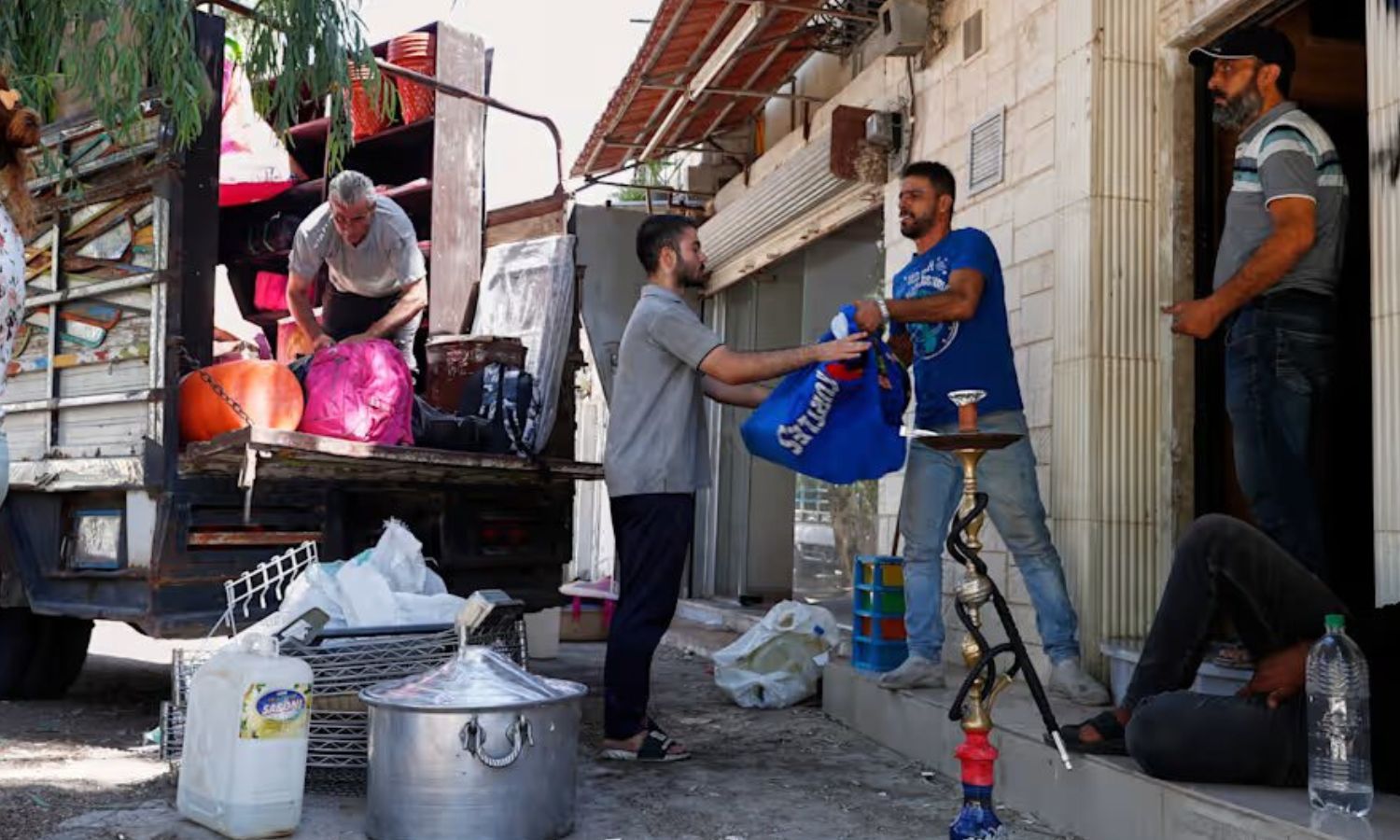
A family carrying their furniture leaves the al-Sumariyah neighborhood, August 30, 2025 (AP)
No compensation
Engineer Mazhar Sharbaji pointed out that the expropriation decree stipulated the planning and subdivision of the properties to become public-benefit areas, but this goal was never achieved due to the Defense Companies’ (led by Rifaat al-Assad) control of the area, and the assignment of the Military Housing Establishment to construct housing for their personnel. This placed the property outside the framework of the law and under military dominance.
He said that al-Sumariyah housing was allocated to non-commissioned officers, while other lands from Muadamiyat al-Sham (Rural Damascus, southwest of the capital) were also expropriated, including land on the right side of the Mazzeh Military Airport road, where buildings were erected for Defense Companies officers (known as al-Zuhariyat), and lands along the Beirut road reaching the “Yasmin” Hotel and the UNRWA building.
He confirmed that the title extract (ikhraj al-qid) for parcel “3603” lists the names of Muadamiyat residents as the legal owners, and none of them received financial compensation, despite small sums being deposited at the Central Bank of Syria in 2009, with the collection deadline extended to 2023. The residents refused to accept the payments, considering the expropriation a “seizure of property,” which constitutes a criminal complaint before the Misdemeanor Reconciliation Court.
According to lawyer Aref al-Shaal, the state controls 85% of Muadamiyat’s area, while residents retain control over only about 15% of their property and land.
Currently, the administrative boundaries of Muadamiyat al-Sham extend from the People’s Palace junction at the end of the Mazzeh expressway (just past the UNRWA building) to the Sheikh Hamad Palace overlooking the Yaafour plain, and from Western Dummar in the north to the borders of Daraya and Jdeidat Artouz in the south.
An official document affirming land ownership
Engineer Hassan Abu Zaid, former head of Muadamiyat al-Sham Municipality, provided Enab Baladi with an official document known as a “Boundary Report” (Mahdar al-Tukhum) issued by the Real Estate Directorate, proving Muadamiyat residents’ ownership of parcel “3603.” In 1966, the land registry recorded the names of 805 owners (the town’s residents at the time). Over time, the number of heirs and owners has risen to more than 200,000.
The parcel is officially registered in the name of Muadamiyat al-Sham residents, based on land-registry extracts (tabu), which function as legal title deeds that take precedence over other laws, decisions, and even court rulings, Abu Zaid added.
He accused the Director of Planning and Urban Organization in Damascus Governorate of “ignoring the facts” and favoring al-Sumariyah residents, relying on decisions by committees formed under the former regime that were subordinate to the security apparatus.
Expropriation of parcel “3603”
The expropriation decree for parcel “3603” states that “the parcel is considered of public benefit and must be expropriated under expropriation plan No. 611, kept with Rural Damascus Governorate, the Ministry of Housing and Construction, and the Presidency of the Council of Ministers, for the purpose of subdividing and organizing it in accordance with Law No. 60.”
Prosecuting former Damascus governors
Abu Zaid asserted that Damascus Governorate violated the text of the expropriation decree and Law No. 60 in several provisions, and that both the Dispute Resolution Committee and the Primary Appraisal Committee committed clear and explicit violations of the Expropriation Law under security pressure, especially as some al-Sumariyah residents had links to security services.
He called for prosecuting and holding to account former governors, foremost among them Bishr al-Sabban, as well as members of the dispute-resolution committee.
He clarified that the first step the committee should have taken was to request the title documents for parcel “3603,” which it deliberately ignored under pressure from security agencies to deny Muadamiyat residents their rights.
No quarrel, only lost rights
Abu Zaid said that under current regulations and laws, including the building code and the law for suppressing violations, any of the following building cases are considered violations and must be demolished:
-
Any building constructed without a permit.
-
Any building encroaching on or over public property.
-
Any building lacking adequate structural soundness.
He explained that the issue is not sectarian or political; it is about clear, proven property rights. Some Muadamiyat residents own homes in al-Sumariyah and were evacuated in recent days, as were families from Syria’s coastal region whose homes were also vacated.
He revealed that al-Sumariyah is inhabited by citizens from various sects, and that Muadamiyat’s residents bear no enmity toward any party in Syria; they only seek restoration of their legal and legitimate rights.

Marking homes in al-Sumariyah with “X” and “O” signs, September 5, 2025 (Enab Baladi)
Partial compensation that does not reflect full ownership
In past years, eight million Syrian pounds were deposited in an account at the Central Bank of Syria in the name of Shihada Sawan, the representative of Muadamiyat residents.
Abu Zaid noted this sum was compensation for the land on which the Damascus–Beirut expressway was built, which is a small part of a parcel adjacent to al-Sumariyah.
He stressed that Muadamiyat residents refused then, and still refuse, for their representative to withdraw or distribute the amount, because the compensation does not cover the entire parcel nor reflect the real value of the land.
Abu Zaid emphasized that Damascus Governorate, by law, has no right to sell or dispose of this parcel because it is designated for public purposes and official institutions.
He underlined that this legal status makes any attempt to sell or allocate the parcel a clear violation of prevailing regulations.
Void expropriation
For his part, lawyer Anwar al-Bunni, head of the Syrian Center for Studies and Research, said the expropriation decisions should have been implemented by the Ministry of Municipal and Rural Affairs and Damascus Governorate, not by the Ministry of Defense. Using the land to build a research center and an industrial research center violates the stated purpose of expropriation, rendering those decisions legally void.
He confirmed that the only authority entitled to administer the expropriation is the expropriating body, and only for the purpose for which the expropriation was made, referring to the Ministry of Municipal and Rural Affairs.
Regarding court rulings on ownership of homes in al-Sumariyah through sale-and-purchase contracts among residents there, al-Bunni explained that such rulings do not affect land ownership. They are judgments concerning the sale of the building carcass (the structure) only and do not grant any legal right to the land.
He said a court ruling is merely a description of the present situation, giving the buyer the right to use the structure, not to own the land on which it stands.
Al-Bunni added that families living in unlicensed al-Sumariyah homes are “unlawful in legal terms,” yet mechanisms must be found to address the problem without the use of force.
He stressed that all installations built on the parcel, such as the research center and the Beirut bus terminal, are also “illegal,” because the expropriation law does not authorize construction on the land, making their existence a violation.
He pointed to the legal remedy: annulment of the expropriation laws through an independent judiciary and returning the land to its owners so they are free to dispose of it.
Proving ownership of the buildings, not the land
Enab Baladi obtained a copy of the court judgment “469 Basis 1089,” issued by the Daraya Civil Conciliation Court in 2011, presided over by Judge Mohammad Ahmad Hijazi.
The subject of the lawsuit was an “assignment of right” (hawalat haqq), a legal agreement by which a creditor’s right is transferred to another person without the debtor’s consent.
The case concerned the sale of a residential apartment within the violations zone located on parcel “3603” in al-Sumariyah, where the court affirmed one resident’s ownership of the unlicensed structure under a sale contract between seller and buyer.
The ruling noted that the defendant obtained a final, binding decision from the Dispute Resolution Committee in the Muadamiyat expropriation area, No. “226 Basis 165” dated April 19, 2005, confirming the objector’s ownership of the building erected on parcel “3603.”
According to the decision, the court acknowledged the owner’s entitlement to the value of the structure as assessed by expropriation committees in Damascus Governorate and upheld the assignment of right between the parties, including rights and obligations, meaning the buyer became the owner of the building, not the land.
On the reverse side of the ruling, the Director of Enforcement at the Daraya Court recorded instructions to send a copy of the judgment to the Real Estate Directorate in Damascus Governorate on December 29, 2011, to register a notation of the ruling on the property sheet for parcel “3603.”

The spark behind the latest turmoil:
Forced eviction?
Tensions in the al-Sumariyah neighborhood (on the outskirts of Damascus) began when armed men in military uniforms delivered 72-hour notices on August 27, accompanied by what residents described as violations.
Three separate al-Sumariyah residents told Enab Baladi that on August 26 a WhatsApp message was posted to the neighborhood group by the area’s security chief stating that the High Housing Committee would examine property titles to determine who holds lawful ownership and who had seized units, with no immediate measures planned.
The next day, however, personnel believed to belong to the Ministry of Defense entered the area instead of the committee, sealed it off, and ordered all residents to evacuate, including those holding titles or court rulings, while issuing reprimands to locals.
The orders cited a “General Housing Committee” document, but it bore no official signature and was merely attributed to the Presidency, according to the paper distributed to residents. Enab Baladi obtained a copy.
Alongside the notices, raids, and reviews of property status were carried out. Dozens of young men were detained, whether civilians or reconciled former fighters, including some under 18. Phones were searched and in some cases confiscated, according to testimonies, with a number later released after beatings.
Residents were told to gather in the square to meet the governor, but the meeting was limited to security personnel, who reiterated the eviction orders. Arguments escalated into shouting, some women were shoved, and the phones of those filming were seized.
No prior warnings
The head of al-Sumariyah’s neighborhood committee, Karam Khuzam, told Enab Baladi that residents had not previously received any eviction notices, contrary to social-media claims, saying warnings were sent only to shops on the main street.
The first notice to residents, he said, was an oral warning on June 3 to those living in the neighborhood’s military housing blocks only, not to people in the surrounding single-story houses (the so-called bayt arabi), delivered by the High Housing Committee.
The notice gave one month, and in less than a month those buildings were fully vacated.
Al-Sumariyah consists of military apartment blocks of four stories, totaling more than 2,000 units.
The single-story houses number about 1,500 and are split into two categories:
About 1,400 houses hold a court ruling confirming ownership (hukm mahkama).
Around 100 houses rely on electricity and water meter registrations as proof of possession.
Karam Khuzam,
Head of al-Sumariyah Neighborhood Committee
The “X” and “O” marks
Upon entering the neighborhood, the military personnel marked homes with an “X” meaning no eviction, and an “O” meaning eviction, according to Khuzam, who said the criteria for the markings were unclear.
In his view, the steps were carried out by untrained personnel without legal expertise. The matter requires a governorate-led committee with the proper mandate and experience.
Khuzam added that roughly 80% of al-Sumariyah has now been vacated. Although the governor assured residents the issue would be resolved and encouraged those who left to return, the military forces on the ground refused their return and demanded a written order from the governorate. When residents asked the governorate for this, they were promised the matter would be handled soon.
The governor promised a solution, denied that there was any “forced eviction,” and said disputes must be resolved by the courts because Syria is a state of law and judiciary, according to Khuzam.
The Interior Ministry told Enab Baladi it had nothing to do with the evictions. The Ministry of Defense did not respond, nor did the neighborhood’s security chief, known as “Abu Hudhayfa.”
“Forced evictions”?
Alaa Younes, a lawyer and legal researcher with the Syrian Legal Development Programme (SLDP), told Enab Baladi that the steps of recent days constitute “forced evictions” carried out outside judicial procedures by “local armed actors,” without proper enforcement orders, adequate notice, or housing alternatives and compensation.
She considered the measures “selective,” applied to al-Sumariyah while similar informal areas were left untouched, raising suspicion of identity-based discrimination, especially in light of violations committed against members of the Alawite community in March. The measures were later frozen, and the file referred to joint legal committees, an implicit recognition that any solution must be through courts and the rule of law.
Human rights activist Rana al-Sheikh Ali told Enab Baladi that in normal daily life outside periods of conflict and authoritarian rule, any right is subject to time limits for claiming it.
The Ministry of Defense bears responsibility for returning property previously seized by it to those harmed. Eviction is not within the ministry’s mandate, displacements should not occur, and such cases must be handled by specialized property and real-estate committees, with alternatives provided, especially in al-Sumariyah.
Rana al-Sheikh Ali,
human rights activist
Al-Sheikh Ali expects the latest evictions will cause displacement, while most residents do not own land in their towns and villages. This risks demographic change, she said, which demands sensitive solutions. Transitional justice in such cases should be shaped by the rights-holders’ perspective, that is, the original landowners, not the state’s view, with victims’ rights respected and the voices of those labeled “violators” also heard, which is a legal requirement.
She added that the Syrian state is the only actor authorized to use force, but that force must be constrained by standards that prevent violations, consider the sensitivity and nature of such disputes, and avoid creating instability. The use of force in al-Sumariyah is therefore unacceptable, she said, stressing that restoring rights should not create new crises, nor should cases be treated uniformly without nuance.
She pointed out a core dilemma: land was seized as open parcels, then became built-up areas. The current residents may be second- or third-generation and not the original owners whose land was expropriated.

The al-Sumariyah neighborhood on the outskirts of Damascus, marked by widespread informal housing – September 4, 2025 (Enab Baladi)
What future for al-Sumariyah’s residents?
Khuzam said residents’ demands begin with physical protection, followed by the formation of legal committees to handle the case. Any solution must be strictly legal, whatever the outcome, and residents agree to abide by it.
Recommendations
Drawing on international practice, human rights activist Rana al-Sheikh Ali suggested that people living in informal housing be addressed through one of the following options:
-
Granting a defined vacate period that could extend up to five years.
-
Creating shared-benefit schemes on the parcel.
-
Providing compensation to the original owners or other pathways.
For SLDP legal researcher Alaa Younes, a just solution must balance three rights: the state’s right to planning and the rule of law; the rights of original owners harmed by unfair or unimplemented expropriations; and the stability of current possessors who have lived there for decades with implicit or explicit official tolerance.
Her recommendations included:
-
An immediate, comprehensive halt to any “forced” evictions in al-Sumariyah and elsewhere until a protective legal framework is finalized.
-
Establishing an independent national Housing, Land and Property rights commission with judicial, cadastral, and community representation, working alongside the UN, to review expropriations, reconcile “original title” with “possession rights,” and propose simplified settlement and registration instruments.
-
A special regulatory settlement for al-Sumariyah: a cadastral and social survey; phased regularization and titling where feasible; and local rehousing and prior compensation for non-regularizable parts.
-
Fair, up-to-date compensation for original owners (cash, alternatives, or development shares) financed by a national fund to fix the file with international support.
-
Legalization of procedures: any future evictions must be court-ordered, with adequate notice, grace periods, appeals, and civic oversight, applying uniform standards without identity-based selectivity and ensuring accountability for violations.
Proposed legal paths
Anwar al-Bunni, head of the Syrian Center for Studies and Research, proposed a housing project on the parcel in which Muadamiyat al-Sham owners (Rural Damascus, southwest of Damascus) would receive 80 percent of the shares as landowners, and current occupants 20 percent, or another mutually agreed ratio.
Al-Bunni said transitional justice requires resolving the informal constructions in al-Sumariyah through legal means.
Engineer r Mazhar Sharbaji proposed that ownership revert to the state under expropriation laws, with Muadamiyat owners compensated through investment projects or residential units, as well as compensation for those who built unlicensed homes on the parcel.
Informal belts around Damascus:
How the narrative formed
Al-Sumariyah is one of many informal districts ringing the capital, populated largely by low-income households and government employees, especially from the military sector.
Most residents of al-Sumariyah hail from Syria’s coastal region. Many were soldiers or officers in the former Syrian army (now dissolved).
For decades, the neighborhood’s location on Damascus’s edge, near sensitive sites such as Mazzeh Military Airport, whose runway lies less than 800 meters from the first buildings, fueled a narrative that Damascus was encircled by informal areas inhabited by regime loyalists to serve as a civilian shield in times of crisis and armed conflict.
Was it named after Sumer, son of Rifaat al-Assad?
Residents interviewed by Enab Baladi recounted that after military and unlicensed housing began to spread over parcel “3603,” Sumer, son of Rifaat al-Assad, purchased the property via checks and transfers and donated it to the Ministry of Defense, which then tasked the Military Housing Establishment with building the al-Sumariyah housing blocks.
According to this account, the area was named “al-Sumariyah” after Sumer and incorporated into military housing, allocated to non-commissioned officers of the Fourth Division.
But the account lacks accuracy: the title to the land never transferred to the state and remained under the names of Muadamiyat owners, apart from the question of whether the state could sell public property in the first place. Enab Baladi was unable to verify, from independent documents or credible studies, the origin of the neighborhood’s name.
Rifaat al-Assad is the brother of former president Hafez al-Assad and the founder of the Defense Companies, later folded into the Fourth Division in 1984. The Defense Companies played a major role in the events known as “the 1980s,” including massacres in Hama and Tadmor Prison during the regime’s war with the Muslim Brotherhood.
How the narrative took shape
Al-Bunni told Enab Baladi that the land grabs in Muadamiyat were not unique and were repeated in Barzeh, Ish al-Warwar, Mazzeh 86, and al-Barida to the south. He argued that former president Hafez al-Assad had a plan to ring Damascus with informal districts, beginning with al-Sumariyah, to besiege and control the capital. Beneficiaries of the regime settled in these areas, explaining their continued defense of the Assads to preserve their privileges.
Abdullah al-Ali, a Syrian political analyst and columnist at Lebanon’s an-Nahar, said Hafez al-Assad’s relationship with Alawites in Damascus was not built on integrating them into planned urban fabric, but on providing marginal housing that kept them close to the capital and made loyalty a matter of existential necessity rather than choice.
He told Enab Baladi that the regime did not build formal residential compounds for Alawites or other loyalists. Instead, it ensured their stability in fragile informal neighborhoods without title deeds, dependent entirely on security protection.
This was not accidental, he argued, but part of the governing method: even loyal constituencies were kept in legally precarious positions, making them more dependent and more protective of their allegiance.
At the same time, this arrangement gave the regime flexibility. Informal areas can be cleared or reshaped when needed, unlike formal compounds that create property rights that are hard to override. Similar strategies have been seen in other authoritarian contexts, he added, where regimes keep their base socially precarious to cement control.

built informal housing in the al-Sumariyah neighborhood on the outskirts of Damascus – September 4, 2025 (Enab Baladi)
A Turning Point
The events involving the Muslim Brotherhood in the 1980s marked a turning point in the history of Syria’s informal settlements, according to political analyst Abdullah al-Ali. He divided them into two categories: those that provided a base of support for the former regime, and others that became strongholds of opposition.
Informal neighborhoods such as al-Sumariyah emerged during this period, some of which Rifaat al-Assad established as housing for Defense Companies officers, while adjacent to them grew the civilian district of al-Shuhada, the center of recent eviction disputes.
Later, other settlements appeared, including Mazzeh 86, Ish al-Warwar, and al-Tadamon, reinforcing the impression of a deliberate policy to encircle Damascus. Al-Ali noted that the opposition considered this a “calculated strategy,” while regime loyalists promoted it as a “clever plan” to shield the capital.
However, he added that Aleppo, Syria’s second major city, also developed extensive informal settlements, most of which leaned toward the opposition. This contradiction, in his view, undermines the claim of a unified, systematic policy to militarily cordon Damascus.
A Failed Strategy
Al-Ali argued that after the fall of the regime, this alleged policy, if ever implemented, proved a failure. Informal settlements never turned into defensive lines. They remained fragile structures without fortifications, and their residents were not systematically armed, only encouraged to volunteer individually in the National Defense Forces. The regime’s real reliance stayed with the army and central security units.
He explained that informal housing was primarily a social and economic phenomenon, later exploited selectively for political purposes. The idea of a “military belt” around Damascus, he added, needs deeper study to assess whether such a policy was ever realistic or beneficial.
Instead, he believes it was an inflated media narrative, entrenched amid the country’s stark polarization, that turned into an “almost mythical idea” lodged in public consciousness, yet one that collapsed in practice.
A National Problem
Al-Ali stressed that informal settlements are a nationwide issue, not limited to Damascus.
As the capital and the hub of political conflict, Damascus received disproportionate attention, becoming the focal point of accusations and propaganda from both sides of the divide.
He noted that stepping out of this cycle requires looking at the map of informal settlements across Syria, where cities such as Aleppo witnessed far greater expansion than Damascus.
The roots of informal housing, he said, lie in economic and social drivers: rural-to-urban migration following land reform and nationalization policies, the Palestinian exodus of 1948 and 1967, and the oil boom of the 1970s that fueled demand for labor.
According to al-Ali, political elites in past decades tolerated the spread of such settlements, sometimes due to weak urban planning capacity, and at other times because they served a political need for cheap housing that guaranteed loyalty. He added that Hafez al-Assad inherited this tolerance, under which informal settlements gradually acquired a political dimension.
The post Al-Sumariyah: A battle over land and identity on the walls of Damascus appeared first on Enab Baladi.