
Enab Baladi – Mohammad Deeb Bazt
Recent developments in Syria point to an undeclared struggle between Israel and Turkey aimed at expanding their military and political influence following the fall of Bashar al-Assad’s rule.
Israel has been using airstrikes not merely as a military tool but as a means of sending signals to Ankara that it will not allow any Turkish military presence that could alter the balance of power inside Syria.
In the context of Israel’s recent strikes on the rural areas of Homs and Latakia (western Syria), some Israeli sources claimed that the raids targeted warehouses containing missiles and air defense systems believed to be of Turkish origin.
However, the Turkish Ministry of Defense firmly denied these reports, stating that “there are no negative incidents involving Turkish forces or equipment in Syria,” and that claims of Israeli attacks on Turkish military assets were “false and do not reflect reality.”
The tension goes beyond airstrikes and includes extensive Turkish movements inside Syria, such as delegation visits to the T4, Palmyra, and Hama airports, in a bid to cement a long-term presence and secure Turkey’s southern border.
Israeli Strikes
In recent months, Israel has intensified its air raids on Syrian territory, targeting sensitive military and security sites as part of a continuous escalation since the fall of Assad’s regime at the end of 2024.
In early April, Israeli warplanes carried out a series of airstrikes on several sites in Damascus, Hama, and Homs, including the Scientific Studies and Research Center in Barzeh (northern Damascus) and the T4 Airbase in Homs, alongside other military installations.
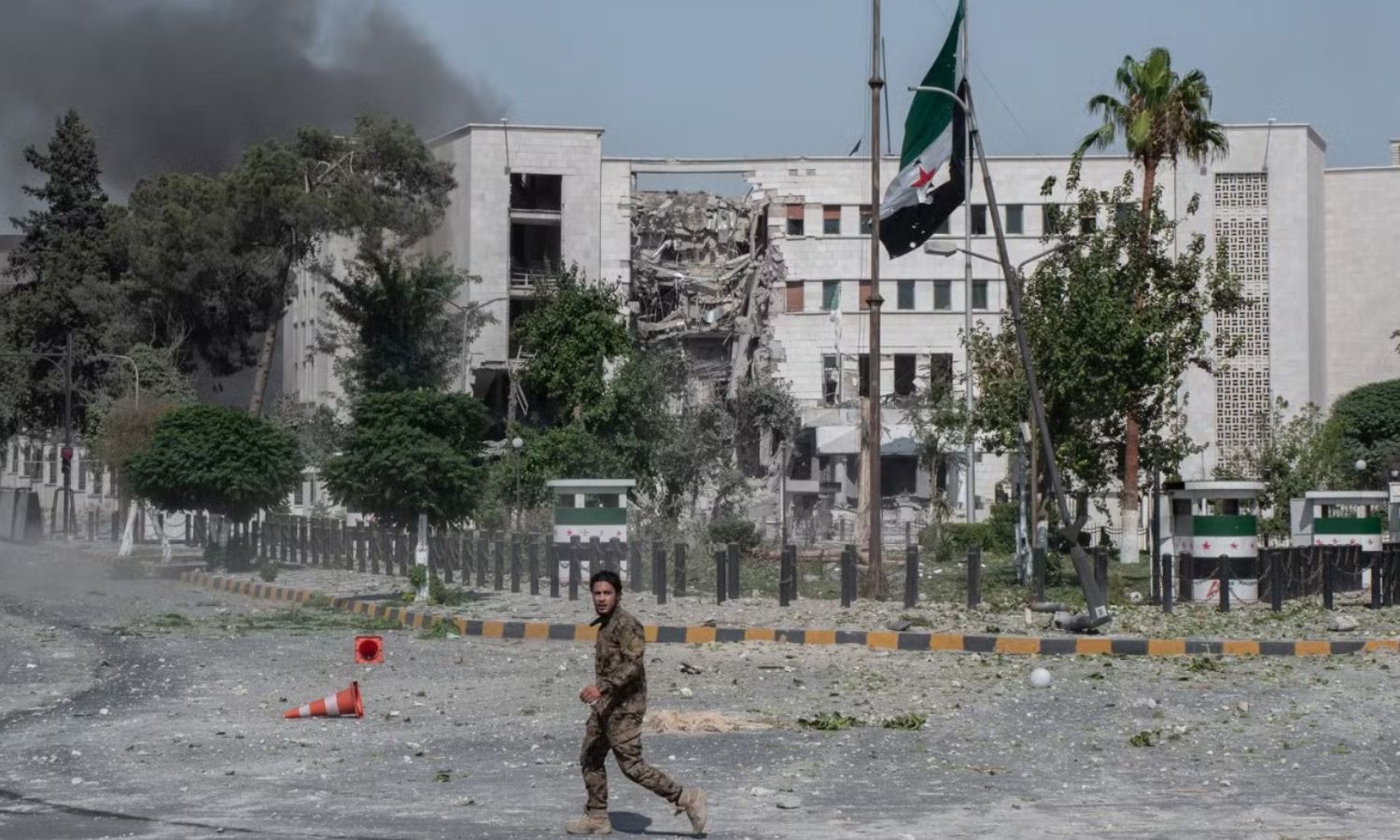
In mid-July, Israeli airstrikes targeted the General Staff building in the center of Damascus, signaling an escalation in Israel’s strategy to prevent any hostile military presence near its borders, particularly in southern Syria.
Israeli attacks in Syria are no longer limited to tactical strikes but have evolved into tools for sending implicit strategic messages, particularly to Turkey, defining the boundaries of influence inside Syrian territory.
This new dynamic turns Syria into a stage for regional friction, where each power seeks to solidify its position while keeping the other under constant surveillance.
Turkey has expressed reservations about the Israeli attacks. Speaking on September 26, after returning from New York where he attended the UN General Assembly meetings, the Turkish president said that Israel’s attacks in Syria aim to undermine efforts for peace and stability, reaffirming his country’s opposition to any military escalation that could affect regional stability.
With the repeated Israeli strikes, Syria is increasingly becoming, according to political analysts, an arena for an implicit confrontation between two opposing regional projects—a Turkish project seeking a long-term foothold and an Israeli project determined to preserve its aerial superiority and prevent any actor from altering the rules of deterrence within Syria.
Strategic Messages
Mohammad al-Jabi, an academic specializing in international relations, told Enab Baladi that Tel Aviv now clearly links the course of its negotiations with Damascus to the extent of Turkey’s role in Syria, considering any Turkish entrenchment inside the country a direct threat to Israel’s air supremacy.
He explained that Israel’s recent strikes in Syria are no longer driven by conventional conflict motives but are directly tied to Turkey’s growing military footprint within Syrian territory.
According to al-Jabi, Turkey’s military visits to airports such as T4, Palmyra, and Hama conveyed a clear message that Ankara views Syria as a strategic sphere it cannot afford to abandon, an extension of its national security.
Israel, he said, quickly picked up on this shift and deemed it a threat to its long-standing air dominance, prompting preemptive strikes on several bases inspected by Turkish delegations. These operations carried an unmistakable message that any Turkish military entrenchment would be treated as a red line.
He added that Israel’s recent actions, including an airdrop operation in the al-Kiswah area (south of Damascus) at the end of August, carried a demonstrative element and a dual message: Israel is capable of reaching any location inside Syria and warns Turkey that attempts at expansion or entrenchment will be met with direct military retaliation.
Al-Jabi noted that this competition reflects Syria’s transformation from a field of Iranian-Russian influence into an arena where conflicting regional projects intersect—one Turkish, seeking to establish long-term influence, and another Israeli, intent on preventing any actor from shifting the deterrence balance.
The implications, he said, go beyond the military sphere, leaving Syrians “trapped in a game larger than themselves,” as their land becomes a platform from which Ankara and Tel Aviv exchange messages.
At the regional level, this competition deepens instability and complicates any efforts toward reconstruction or lasting political settlement.
A Central Player
Political writer Jafar Khadour told Enab Baladi that Israel’s airstrikes in Syria carry messages primarily directed at Turkey.
He said that through the recent attacks, which destroyed several Syrian military capabilities, Israel sought to convey to Ankara that dealing with it in the future Syrian landscape must be based on an “official and weighty partnership,” not as a secondary actor in the equation.
According to Khadour, these messages mean that Israel will not allow Turkey to become the dominant power in Syria.
He argued that Israel is closely watching alliances involving Turkey, Qatar, Saudi Arabia, and Jordan, believing they could shape the future of economic influence in post-war Syria.
This, Khadour said, underscores a wider regional race to draw new influence maps, with Tel Aviv viewing itself as a central player in this contest—especially after consolidating its presence across several fronts, which pushed it to evolve its traditional security doctrine toward one based on “striking anywhere and anytime deemed necessary.”
Khadour concluded that while Israel aims to cement its place in the regional equation, its success ultimately depends on the direction of future U.S. involvement in the region, making it too early to speak of a fixed Israeli dominance.
The post An Israeli-Turkish Struggle for Influence in Syria appeared first on Enab Baladi.
from Enab Baladi https://ift.tt/3SPLijI
via IFTTT