
Fighting between the Syrian army and the Syrian Democratic Forces (SDF) in the Sheikh Maqsoud and Ashrafiyeh neighborhoods of Aleppo (northern Syria) came to a complete halt on Tuesday, October 7, following a ceasefire agreement, according to the state-run al-Ikhbariyah TV channel.
Enab Baladi’s correspondent in Aleppo reported that the ceasefire followed exchanges of sniper fire and artillery and mortar shelling that had reached civilian areas elsewhere in the city.
One Killed, Several Injured
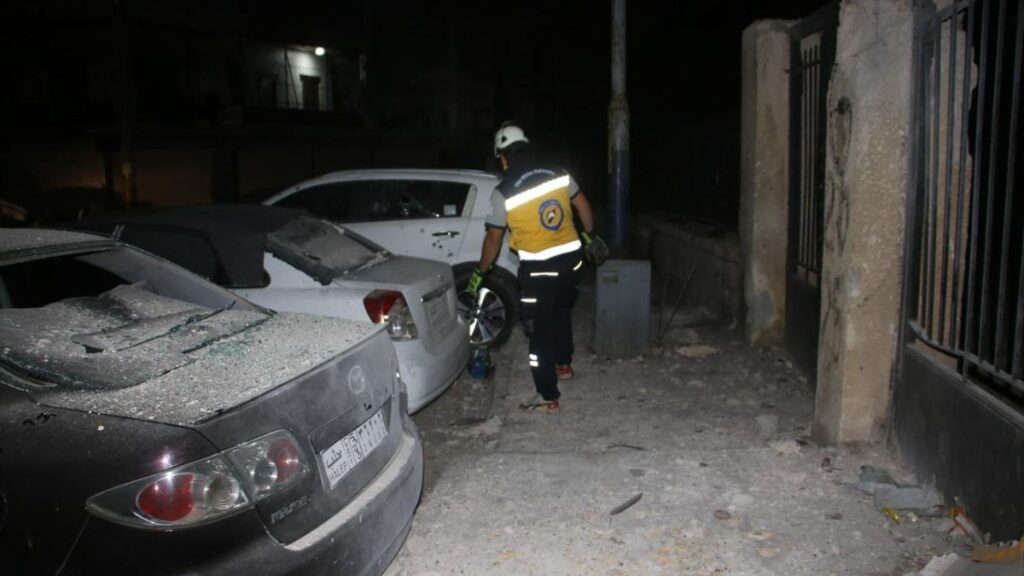
The Syrian Civil Defense announced that one civilian was killed and five others, including two women, were injured by rocket attacks launched by the SDF targeting Aleppo city on the evening of Monday, October 6.
In a statement posted on Facebook on Tuesday, October 7, the Civil Defense confirmed the death of one civilian and the injury of another in a rocket attack by the SDF that struck the Saif al-Dawla park area in Aleppo. Emergency teams transferred the victim’s body to the city’s forensic medicine department and inspected the site.
A young man and his mother were also injured by a rocket strike near their home in the Midan neighborhood, while a woman was wounded by gunfire during clashes near the Sheikh Taha area. Another man was shot in the leg and shoulder in the al-Siryan neighborhood.
The Civil Defense added that its teams extinguished a fire that broke out in a house and warehouse in Sheikh Taha as a result of the fighting between the Syrian army and SDF.
Schools Closed, Exams Postponed
Aleppo Governor Azzam al-Gharib announced the suspension of classes and postponement of exams in schools, universities, and public offices on Tuesday, citing the current security situation. He noted that institutions providing medical and emergency services were exempt from the decision.
Al-Gharib urged residents to stay home and avoid areas near the clashes, emphasizing that the government forces had no intention to escalate militarily and that efforts were underway to contain tensions and restore calm.
In a Facebook post, al-Gharib said the redeployment of government forces on the city’s outskirts came in response to what he described as repeated “violations” by the SDF, supported by “remnants of outlawed groups.”
What Happened?
According to al-Ikhbariyah, the clashes began after the Syrian army discovered a tunnel dug by the SDF connecting its positions to areas behind army and security points near Ashrafiyeh. The army reportedly destroyed the tunnel and redeployed around the two neighborhoods, while internal security forces set up checkpoints to prevent SDF fighters from infiltrating.
The channel claimed that SDF fighters disguised in civilian clothes clashed with security personnel using sticks and stones, during which armed SDF members opened fire on internal security posts and shelled adjacent neighborhoods with mortars.
An internal security source told al-Ikhbariyah that one officer was killed and three others were injured in SDF attacks on security checkpoints near Sheikh Maqsoud.
Prior to the clashes, Syrian army reinforcements had arrived in Aleppo, and all entrances to Sheikh Maqsoud and Ashrafiyeh were closed to vehicles, causing heavy traffic jams. Civilians were allowed to leave the neighborhoods but not enter them.
The Ministry of Defense’s Media and Communications Directorate told the Syrian Arab News Agency (SANA) that army movements were part of a broader redeployment plan across northern and northeastern Syria in response to “repeated SDF violations,” including attacks on civilians, soldiers, and security forces, as well as attempts to seize new areas. The ministry reaffirmed its commitment to the March 10 agreement between the government and the SDF and denied any intention to launch military operations.
The SDF, for its part, said the Aleppo events were provoked by “pro-government factions” attempting to advance with tanks. It denied targeting army checkpoints around the two neighborhoods, stating on Facebook that the reports were “baseless.”
A military source, speaking to Enab Baladi on condition of anonymity as he was not authorized to speak to the media, said the government had pressured the SDF to withdraw and place the neighborhoods under the supervision of state security. Under this arrangement, the Sheikh Maqsoud and Ashrafiyeh neighborhoods would remain under Syrian state authority without the presence of armed checkpoints inside the city.
He added that negotiations held about two weeks earlier failed because the SDF rejected government terms, while the government refused SDF-linked factions’ proposals, resulting in the recent escalation.
According to the source, the government decided that no armed faction operating outside state authority would be allowed to remain in the city, and any further escalation would be part of efforts to reimpose control and ensure security.
Tensions Before the Clashes
Tensions in Sheikh Maqsoud and Ashrafiyeh had already resurfaced on September 22 when the Syrian army sent convoys, including armored vehicles, to the neighborhoods’ perimeters to strengthen its positions opposite the SDF.
A military source told Enab Baladi that the tensions began when the SDF targeted a Ministry of Defense pickup truck, killing one soldier and injuring four others who were subsequently captured. The city saw heightened security in the aftermath.
The source explained that Ministry of Defense units are stationed at fixed positions around the two neighborhoods, opposite SDF points inside them. The September incident occurred during a routine troop rotation.
While the government did not comment on the incident at the time, an Aleppo governorate source told Enab Baladi that the situation was resolved the same day and that the SDF released the captured soldiers.
The SDF said it had repelled an attack by what it called “rogue militias” loyal to the Damascus government on one of its security points near Sheikh Maqsoud and Ashrafiyeh. According to the group, the confrontation left three attackers wounded and brought down a drone used in the assault.
The post Clashes End in Aleppo’s Sheikh Maqsoud and Ashrafiyeh Neighborhoods in northern Syria appeared first on Enab Baladi.