
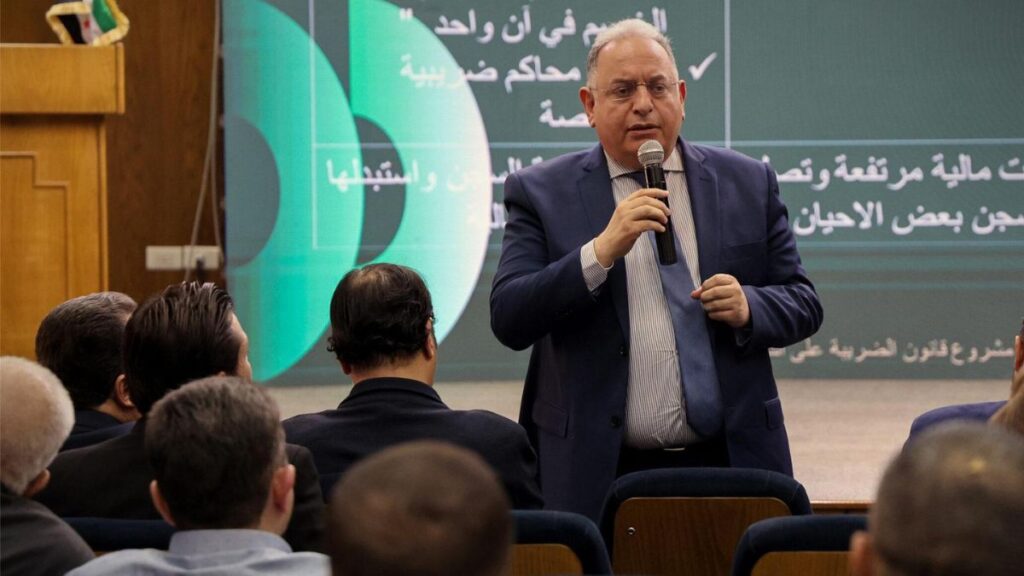
Syrian Finance Minister Mohammed Yosr Bernieh said on October 1 that “the tax on industrialists will be only 10% under the new tax system, and 25% of sales tax revenues will be allocated to supporting industry and exports.”
The minister’s remarks came during his meeting with industrialists at the annual gathering of the Damascus and Rural Damascus Chamber of Industry, held at the Golden Mezze Hotel, according to the state-run Syrian Arab News Agency (SANA).
In recent days, Bernieh has intensified meetings, workshops, and consultations with industrialists, merchants, and their representative bodies such as the boards of chambers of commerce and industry across Syrian provinces, at the Finance Ministry headquarters, in preparation for launching the new tax system, as he also confirmed via LinkedIn.
According to Bernieh, the government is adopting a principle of genuine partnership with chambers of commerce and industry in shaping economic policies, especially in drafting the new tax system, stressing that no future decisions will be issued without prior dialogue with industry representatives.
The minister also clarified that there will be full tax exemptions for industrial facilities that have been damaged or destroyed until they are rehabilitated, without specifying whether this exemption is part of the new tax system or a separate decision.
Minister’s authority over annual tax changes
Article 9 of the draft sales tax law (intended to replace the consumer spending tax) allows the finance minister to modify the sales tax rate annually by decree, with the approval of the General Secretariat of the Presidency, provided that the adjusted rate does not exceed 50% of the current tax rate.
The minister may also amend the annexed tax schedules, adding or removing items, after approval by the General Secretariat of the Presidency.
These schedules include general and specific sales tax rates on all consumer goods and materials, whether live or processed.
Wine at the top, pork at the bottom – taxwise
According to the draft law’s general sales tax schedules, a 5% tax would be imposed on “live animals of the swine species,” as well as on “fresh, chilled, or frozen pork,” and on “pure pig fat and lard not rendered or otherwise extracted.”
Meanwhile, products subject to special sales tax would carry an additional levy of up to 45% for items such as “live pigs,” and up to 85% for items like “wine from fresh grapes, including fortified wines.”
Bernieh: Lower than regional and global levels
Despite these high rates on specific goods, Bernieh wrote on LinkedIn in September, after the draft sales tax law was completed, that the proposed rates are “the lowest compared to similar rates in countries of the region and the world.”
He added that, for example, the rate stands at 20% in Morocco, 19% in Algeria and Tunisia, 17% in Egypt and Sudan, 16% in Jordan, 15% in Saudi Arabia, 11% in Lebanon, and around 24% in most European countries, noting that the ministry proposed 5% for the general sales tax.
The finance minister considered the draft law a “prelude to a value-added tax,” calling it a “fundamental shift and an important step in the course of tax reform, in terms of competitiveness, fairness, simplification, and the complete exemption of food and basic goods from taxation.”
Many governments worldwide prefer to implement value-added tax (VAT) due to its high revenue yield and its role as a replacement for multiple other taxes. VAT is an indirect tax on the consumption of goods and services, ultimately borne by the consumer, but collected at every stage of the economic cycle—from production, through distribution, to consumption—by the taxpayer, who remits it to the tax authorities under defined regulations.
Tripartite committee to review customs tariffs
Bernieh also revealed, during meetings with industrialists and merchants, the creation of a joint committee composed of the Ministries of Finance and Economy and Industry, and the Syrian Authority for Land and Sea Ports. Its mission is to “review customs tariff laws, prohibitions, and exemptions in line with industrial and commercial stakeholders’ feedback,” referring to bans on importing certain goods and facilitations granted to others.
The minister said the aim of these measures is “to grow the national economy and increase exports, which have declined by 90% since 2010,” stressing that the state will not abandon any facility contributing to production and development and will continue to provide the necessary support to ensure the survival of national industry.
Industrialists’ demands
The Damascus and Rural Damascus Chamber of Industry emphasized its cooperation with the government, according to its chairman, Mohammed Ayman al-Moulawi, who said during the annual meeting that the chamber worked to:
-
Secure protection for facilities and exempt production lines from customs duties.
-
Exempt electricity bills from additional charges and reduce the price of fuel oil and gas.
-
Suspend Decree No. 8 of 2021 (the Consumer Protection Law) and the consumer spending tax.
-
Submit a proposal to amend taxation.
Several industrialists also raised challenges, including:
-
High production costs.
-
Inability of their products to compete with imported goods.
-
The need for a meeting with industrialists in Adra Industrial City.
-
The necessity of including chamber representatives in committees reviewing customs tariff items.
-
Difficulties in shipping goods and delays in processing transactions.
Meeting with chambers of commerce
At another workshop on October 2 with provincial chambers of commerce boards, Bernieh announced a 25% tax exemption for taxpayers who spend on community projects. He explained that the nearly completed tax system aims to achieve fairness and reduce burdens on taxpayers.
Meanwhile, businessman and investor Mohammed al-Shaer, chairman of al-Shaer Chemical Group, discussed during the workshop the draft sales tax law and amendments needed to Legislative Decree No. 11 of 2015 on consumer spending tax, which the new law is set to replace.
The post Syrian Finance Minister Controls Tax Rates with Presidential Approval appeared first on Enab Baladi.