
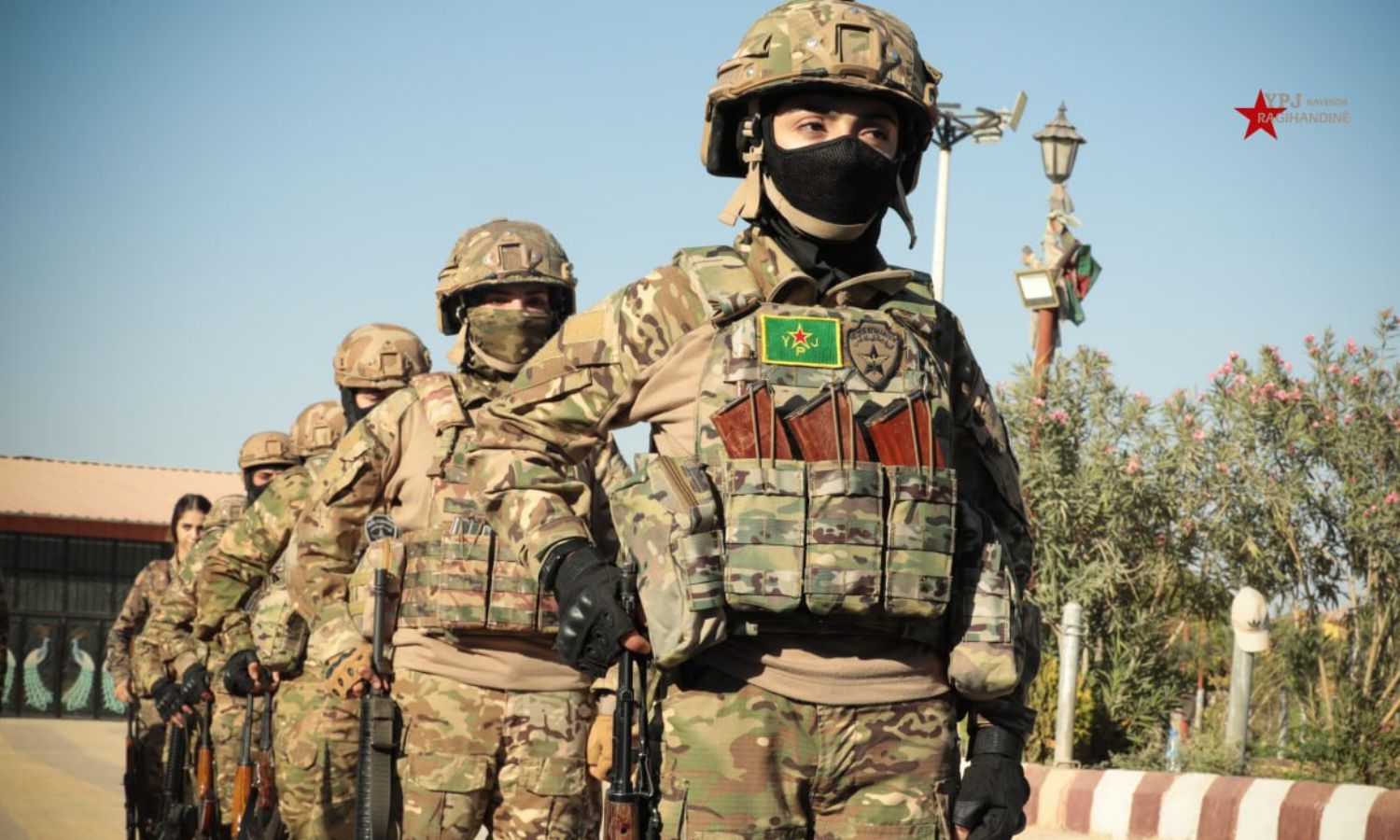
Muwafaq al-Khouja | Mohammad Kakhi | Obada al-Sheikh
Signs are mounting of a possible military escalation between the Syrian government and the Syrian Democratic Forces (SDF), particularly after official statements from Damascus and Ankara warned of a confrontation if the status of the forces controlling northeastern Syria is not resolved before the end of the year.
On October 3, an SDF fighter appeared before a military convoy in Deir ez-Zor (eastern Syria), saying in broken Arabic that the convoy was heading to the Deir Hafer fronts (east of Aleppo) and that the fighters were ready to protect all Syrian provinces “up to the coast.”
In Raqqa, the SDF launched a wide arrest campaign targeting hundreds of people accused of evading compulsory military service. The campaign extended to other regions and provinces.
On the other side, Syrian and Turkish military preparations and reinforcements suggest growing pressure on the ground.
A military source in Syria’s Ministry of Defense told Enab Baladi on September 29 that Kuweires Military Airbase (eastern Aleppo countryside) had been “secured” after Turkish armored vehicles of the Samur type were deployed inside, alongside air-defense systems and Turkish helicopters. Several Syrian army units were also deployed around the airbase and in the border cities of Ras al-Ain (in al-Hasakah province on the Syrian-Turkish border) and Tel Abyad (in Raqqa province on the Syrian-Turkish border).
Sources in the village of Hmeimeh (Aleppo countryside) confirmed to Enab Baladi that the Deir Hafer road leading to SDF-held areas had been closed.
Taken together, these indicators point to a potential battle in northeastern Syria between the Syrian and Turkish armies on one side and the SDF on the other. Enab Baladi discusses with researchers and experts the likelihood of such a confrontation, international reactions to it, and the possible scope of operations.
Filling manpower gaps or draining an opposing base?
Arrests feeding conscription
The Syrian Democratic Forces (SDF) have intensified compulsory recruitment campaigns under what they call the “duty of self-defense,” extending across Raqqa, Deir ez-Zor, and al-Hasakah provinces in northeastern Syria. The campaigns have triggered widespread public concern over arbitrary detentions and the recruitment of minors.
At the end of September, the SDF Military Police launched a large campaign in the city of Raqqa and its countryside, detaining more than 500 people in Raqqa alone. Local sources said the arrests were random and involved violations in the detention process and the targeted age groups.

Live-fire training by the 42nd Division of the Syrian army – 7 July 2025 (Ministry of Defense)
According to activist Fares al-Dakhira, the Raqqa campaign was marked by surprise and arbitrariness, unsettling residents as checkpoints did not adhere to the officially designated age brackets. The checkpoints relied more on “appearance” than on verifying IDs.
This approach led to the detention of teenagers below the legal age for conscription, including a 14-year-old student on his way to his institute, in addition to men over 30. Some were later released, al-Dakhira said.
Najla al-Jalil from Raqqa said fear of arbitrary arrest compelled her to keep her son, born in 2008 and not eligible for conscription, at home until the end of the campaign.
Nasser al-Hashemi said panic spread through the city, prompting some institutes to close or impose strict precautions.
On 22 June 2024, the Autonomous Administration set the birth years required to join SDF military ranks, stating that those born between 1998 and 30 June 2006 must perform “self-defense duty in the North and East Syria region.” It added that “anyone turning 18 must report to self-defense centers to obtain a duty card.”
The Administration’s policy has long involved repeated arrest campaigns to conscript youths, even children, for roughly a year, during which they receive military training and ideological lessons on “Ocalan’s thought,” often by cadres from “Qandil,” before being sent to the front lines.
Compulsory conscription, imposed by the Autonomous Administration in November 2017 on both males and females in its areas, obliges residents to serve in its military and security forces to defend its territory and borders, similar to mandatory service once enforced by the former regime’s forces.
Spreading into Deir ez-Zor and al-Hasakah
Amer al-Mathqal, a researcher at the Syrian Dialogue Center, explained that the campaign did not stop at Raqqa city. It reached the road linking Raqqa with Aleppo via Deir Hafer, where the SDF set up surprise checkpoints and detained young men.
An Enab Baladi correspondent reported several detentions in Deir ez-Zor’s countryside at the al-Jaabi checkpoint, though no precise tally was available.
“Ahmed” from Deir ez-Zor (Enab Baladi withheld his last name for his and his brother’s safety) said the SDF arrested his brother in al-Shaddadi (southern al-Hasakah) and transferred him to a training camp at the al-Jabseh oil field (southern al-Hasakah), indicating oil facilities are being used as collection and training hubs for forcibly conscripted recruits.
Rising tension
Families fear these conscription drives aim to plug manpower gaps and feed the front lines ahead of potential battles, putting their sons’ lives at risk.
Louay al-Ahmad, a journalist from Deir ez-Zor, said by embracing forced conscription, the SDF is risking pushing youths into a war “that is not theirs,” with little regard for the human toll and the devastation it would bring to the region.
Political researcher Firas Alawi told Enab Baladi the SDF is enforcing a “fait accompli” policy in its conscription operations and is escalating pressure on local communities to force families to send their sons to its ranks. He tied this directly to the latest political and military escalation with the Syrian government.
Journalist Basel al-Mohammad told Enab Baladi the campaign goes beyond a routine security measure. It reveals mounting SDF tension with its local environment on one side and with Damascus on the other, amid a highly sensitive regional and international climate.
Mistrust among Arab tribes, Damascus watching
While political circles speak of a deadlock in implementing the 10 March agreement between Syria’s transitional president Ahmad al-Sharaa and SDF commander Mazloum Abdi, the SDF has tightened its security grip via arrests and forced conscription to control an increasingly volatile interior, especially as resentment rises among Arab tribes in Raqqa and Deir ez-Zor, according to journalist Basel al-Mohammad.
He argued that SDF apprehension over tribal movements is pushing preemptive steps that could backfire by widening the gap with its social base and increasing the risk of confrontation.
For its part, Damascus is biding its time and urging tribal restraint while signaling readiness to exploit any internal SDF rupture, al-Mohammad said.
Researcher Amer al-Mathqal believes the SDF fears a new military operation against it, whether broad or limited, intended to pressure it to implement the 10 March agreement. It is being prepared by swelling its ranks. If understandings with Damascus fail, however, these arrests will not be effective, he added, because SDF is sending poorly trained fighters into potential confrontations. Many could flee at the first opportunity, especially Arab members whom the SDF tends to place on the front lines.
For al-Mohammad, the arrests are a “warning bell” of what is to come, reflecting what he called the SDF’s “predicament” between internal and external pressures and revealing a tinderbox that could ignite at any moment.
The broad compulsory conscription campaigns and ongoing raids on villages and towns carried out by the SDF under the label of “self-defense” are merely attempts to compensate for the severe shortage in its ranks and reflect its growing anxiety over regional and international shifts.
This escalation coincides with the noticeable rapprochement between Damascus and its regional and international surroundings, which has significantly undermined the SDF’s leverage and its previous reliance on foreign intervention to consolidate control over the region and its resources.
Louay al-Ahmad
Syrian journalist
“SDF” denies conscription
Despite accounts from activists and residents in northeastern Syria, the SDF denied accusations of forced conscription in Raqqa as “wholly false.”
In a 1 October statement, it described what happened as a “routine security procedure to verify IDs and ensure the integrity of identification documents,” claiming it was intended to “maintain stability and security” against breaches.
Political analyst Hassan al-Nayfi told Enab Baladi the denial fits the SDF’s “policy of denial,” arguing it routinely rejects accusations of mobilization and compulsory conscription, especially of minors.
Researcher Amer al-Mathqal similarly downplayed the denial, saying the SDF habitually counters facts reported by activists from its areas with denial and rebuttal.

Live-fire training by the 42nd Division of the Syrian army – July 7, 2025 (Ministry of Defense)
Turkey steps in
Diverging approaches between the Autonomous Administration and Damascus
Damascus withdrew from Paris-hosted talks planned in July and demanded negotiations take place in the Syrian capital only. Autonomous Administration foreign relations chief Ilham Ahmed last met Syrian Foreign Minister Asaad al-Shibani in late August.
Twice, the Administration said its committees were ready and waiting for official appointments from the Syrian government to resume direct meetings on integrating administrative and military institutions. Damascus has issued no public statements on resuming talks or committee work.
The Syrian government denied media reports that al-Shibani refused to meet Ilham Ahmed in early October. An official source told Enab Baladi on 4 October, “We deny what was circulated in some outlets regarding Damascus’ refusal to receive an SDF delegation,” explaining there had been “no scheduled appointment to begin with,” and that the delegation arrived without prior coordination.
Al Arabiya Net had cited two sources, one close to the Syrian Foreign Ministry and one from the Autonomous Administration, claiming the foreign minister refused to meet because he objected to U.S. officials’ participation in the anticipated meeting, which was to discuss implementation of the 10 March agreement signed by President Ahmad al-Sharaa and SDF commander Mazloum Abdi.
In a 19 September interview with Turkey’s Milliyet, President al-Sharaa said “certain wings within the SDF and the PKK” disrupted implementation and slowed the process.
He told state-run al-Ikhbariyah TV there had been progress in talks with the SDF, but also obstruction or slow-rolling, adding that Damascus had aimed to implement the agreement by the end of December.
Military affairs researcher Nawar Shabban told Enab Baladi the deadline Damascus gave the SDF seems logical, allowing the SDF time to weigh its options and possibly avert a military showdown.
Yet indicators so far do not suggest anything tangible will change when the deadline ends, he said, as the SDF appears to have made its choice.
Analyst Hassan al-Nayfi said the SDF is dragging its feet on the agreement, prompting reciprocal escalation, especially from the central government, which now seems nearly certain the SDF has no intention of implementation.
He argued SDF demands rose after events in Suwayda, including the call by Druze spiritual leader Hikmat al-Hijri for self-determination and separation.
The SDF, he said, sees in these calls a pretext, betting on Damascus’ weakness on internal files and minority dynamics, and raising its ceiling to press for a federal system or political decentralization, both unacceptable to the central government, making a military clash likely, especially with Turkey and possibly with Damascus.
A careful distance between Damascus and Ankara
Although Damascus and Ankara both reject any separatist project in northeastern Syria, Damascus leans toward negotiations and integrating the SDF into state institutions to avoid a new war. Ankara insists on keeping the threat of force on the table, viewing SDF stalling as a direct threat to Turkish national security.
President al-Sharaa has repeatedly said Damascus favors talks and that he persuaded Ankara not to launch an operation against the SDF after Assad’s ouster, giving negotiations a chance. Speaking to Milliyet, he added, “If integration is not achieved by December, Turkey may take military action.”
Turkey’s foreign and defense ministers have likewise warned of military steps if SDF “procrastination” continues.
For Shabban, Turkey’s priority is national security, while Damascus prioritizes de-escalation, unifying ranks, and asserting sovereignty. Restoring sovereignty through a new military campaign would be costly with bigger repercussions, so talks are preferable to Damascus. The difference with Ankara is not sharp; despite the security angle, Turkey appears willing to wait for the talks’ deadline to judge outcomes.
Political researcher Maen Tallaa said Ankara now uses a multi-tool approach to the SDF file. It has moved beyond a purely defensive border approach, like in 2015, to an offensive posture aimed at imposing conditions on the ground. Turkey is leveraging regional circumstances and international backing for Syrian stabilization to push the SDF to narrow its security and political options and make negotiations its only path.
While today’s politics look more conducive, Tallaa said ruling out force is impossible, especially as international positions shift and a new regional security order takes shape. Limited moves, drones, and tighter border control could pressure the SDF to concede more in talks with Damascus or Ankara.
By contrast, Tarek Hamo of the Kurdish Center for Studies argued that while Turkey threatens action against the SDF, it is simultaneously pursuing internal dialogue with the Kurdish movement, making a wide confrontation unlikely given delicate domestic balances and President Recep Tayyip Erdoğan’s interest in preserving a peace process. He sees current Turkish threats as political pressure tools intended to push Kurdish actors toward flexibility and to reassure nationalist constituencies wary of the peace track.
Hamo added that repeating large-scale operations like those in 2016, 2018, and 2019 seems unlikely. Integration remains on the table for the SDF, either by joining the Syrian army or by participating in a Damascus-led political process that recognizes Kurdish rights within a decentralized framework.

An SDF (Syrian Democratic Forces) fighter during the graduation of a batch of special forces – August 13, 2025 (SDF/Media Center)
If battle begins…
Where does the U.S. stand?
The United States, through its special envoy to Syria, Thomas Barrack, is trying to accelerate integration between the Syrian government and the Autonomous Administration.
On 11 August, Barrack warned the SDF it would face problems with both Damascus and Ankara if it failed to move quickly toward integration. On 9 July, he accused the SDF of stalling, saying there was only one path forward and it led to Damascus.
Washington also recently reassigned several senior diplomats on the Syria file. According to Reuters, those affected had worked under Barrack, and a Western diplomatic source linked the move partly to “differences of view” with Barrack over the SDF–Damascus relationship.
Tarek Hamo argued that U.S. policy in the northeast goes beyond short-term calculations, with the Pentagon managing the file and having built a long-term relationship with the SDF that is strategic as well as military and humanitarian. That makes a near-term U.S. abandonment of the SDF unlikely. Washington, he said, still sees Damascus as a partner despite diminished enthusiasm after the coastal and Suwayda events. But the military track is squarely with the Pentagon, and cooperation with the SDF remains central to counter–Islamic State operations, unlike the limited cooperation with Syrian government forces, given U.S. concerns over the composition and ideology of factions inside the new Syrian system.
By contrast, political researcher Firas Haj Yahya cautioned that betting on Washington is always “risky.” U.S. policy in Syria has never rested on long-term commitments but on managing balances. From Barrack’s changes and his calls to hasten integration, Haj Yahya infers Washington does not view the SDF as a permanent entity but as a force that must be folded into Syrian state institutions to achieve relative stability. Washington will not defend a permanent decentralization project indefinitely; it is using it now as a bargaining chip. A realistic SDF course, he said, is to reach a settlement with Damascus that guarantees cultural and administrative rights without infringing on state unity and sovereignty.
Damascus vs. SDF… a military assessment
Col. Khaled al-Mutlaq, researcher in military affairs
No single party can define the balance of forces between Damascus and the SDF, there are too many variables. Still, the SDF has much better discipline, structure, training, and combat work. If the U.S. does not abandon it, it would enjoy air cover, and air cover decides battles.
As for the Syrian army, it still operates in factionalized form with very weak tactical training; it is not a unified army but groupings that fight with simple plans much like in the days of the revolution.
Armies differ from factions. A unified army requires discipline, central leadership, and a combined operations room insulated from fragmentation. We have yet to see that. We saw failed entries, on the coast, where discipline was absent, and in Suwayda, where there was no proper mobilization.
Defenders are stronger… Turkish intervention would be decisive
Defenders are always stronger. In standard doctrine, to attack a battalion, you need three battalions, and to attack a brigade, you need a division. The attacker must bring three times the defender’s strength. The army’s condition is still shaky. With air cover and direct Turkish involvement, matters could be decided partially, perhaps entirely, because air and missile strikes alone do not end a battle unless synchronized with ground advances.
With direct Turkish involvement, outcomes could be decided partially. The SDF is well prepared defensively, relying on fortified works, tunnels, trenches, and strongpoints. As we saw in Gaza, Israel, with all its power, could not decide the battle due to tunnel warfare. Similarly, Turkey has not eliminated the PKK despite anti-tunnel munitions and fires.
The battle, as it might be
From a military angle, a limited operation to take Deir ez-Zor and Raqqa, areas with relatively small Kurdish populations, appears possible, after which the SDF would retreat to al-Hasakah and Qamishli. That is likely the maximum scope: reducing the SDF footprint in select areas rather than a sweeping war. I suspect this is politically understood.
Turkey’s role would likely be logistical support; I do not expect a ground entry. No battle starts without a political decision. Turkish forces will likely not join on the ground; they may provide air or logistical support. A ground decision would create a larger theater. The Turkish army is highly capable, but such a move requires a political green light that does not exist now.
No major player today benefits from eliminating the SDF except Turkey. Ankara, however, has political ties with the U.S. The U.S. will not abandon the SDF because of its key role against the Islamic State and the difficult missions it has executed. So it cannot be erased in the field or politically, militarily, because of deep defensive lines, tunnels, berms, strongpoints, and operations centers; politically, because the U.S. will not give it up.
We must also factor in possible Iranian and Iraqi militia intervention to open an eastern Syria front. That would scramble the deck, and no one could predict outcomes, especially if a forthcoming operation in Lebanon pushes Hezbollah north. If Hezbollah moves north, a confrontation between the Syrian army and Hezbollah could erupt along the Lebanese–Syrian border.

The post War drums beat in eastern Syria appeared first on Enab Baladi.
from Enab Baladi https://ift.tt/GBx4jD6
via IFTTT