
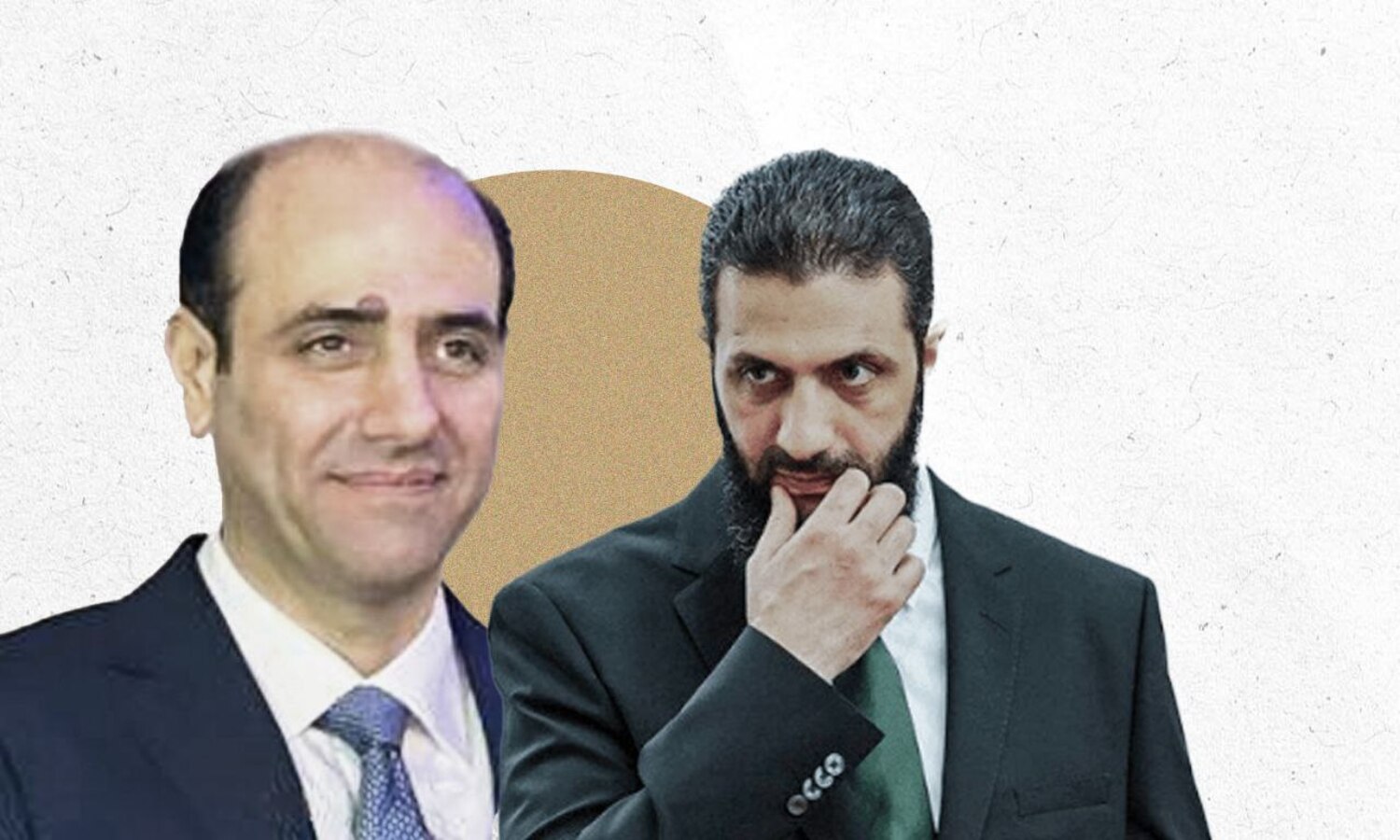
An investigation conducted by Reuters revealed that Syria’s transitional president, Ahmad al-Sharaa, in his efforts to rebuild Syria’s economy, enlisted his brother Hazem al-Sharaa, who is secretly overseeing deals aimed at taking control of major companies.
A covert “shadow” committee is restructuring Syria’s economy by secretly seizing Assad regime companies, led by Hazem al-Sharaa and an Australian man known as “Abu Maryam,” who is subject to European sanctions.
Decoding Corruption
To decode corruption, the committee is making deals with businessmen widely associated with the Syrians with years of illicit gain under the former regime.
According to Reuters, after the regime’s fall, a prominent businessman received a call from someone inviting him to meet “the Sheikh” at a location known during Assad’s economic empire for routinely extorting businessmen. But now, new leaders are in charge.
Wearing a long beard and with a pistol on his hip, “the Sheikh” introduced himself as “Abu Maryam,” head of a committee tasked with restructuring the economy.
The businessman said, “He asked about my business and how much money we make, and I kept looking at the gun the whole time.”
Investigations by Reuters revealed that the new Syrian leadership is secretly restructuring an economy devastated by corruption and years of sanctions imposed on the Assad regime, under the supervision of a group of men whose identities remain hidden under aliases.
Reuters based its findings on interviews with more than 100 businessmen, intermediaries, politicians, diplomats, and researchers, along with a trove of documents including financial records, emails, meeting minutes, and newly registered company records.
The committee’s mission, according to Reuters, is to decode the economic legacy of the Assad era, then decide what should be restructured and what should be retained—away from public oversight.
The committee acquired assets valued at over $1.6 billion, based on insider accounts of acquisitions of company shares and cash seizures, including at least $1.5 billion seized from three businessmen.
It also seized companies in a conglomerate previously controlled by Assad’s inner circle, including the main telecommunications company worth at least $130 million.
Hazem al-Sharaa and Abraham Sukkarieh
The man overseeing Syria’s economic restructuring is Hazem al-Sharaa, the elder brother of the new president. The committee’s leader is an Australian known as Abu Maryam or Ibrahim bin Masoud. His real name is Abraham Sukkarieh, an Australian of Lebanese descent, listed under international sanctions in his home country for financing terrorism.
Despite the dismantling of Syria’s notorious security and intelligence apparatus by the new government, allowing people to speak more freely, the fusion of family ties and men known only by noms de guerre now controlling the Syrian economy has raised concerns among many businessmen, diplomats, and analysts who fear the replacement of one “palace oligarchy” with another, according to Reuters.
The Syrian government has not publicly acknowledged the committee’s operations—nor even its existence. It remains unknown to the broader Syrian public. Only those who deal with it directly are aware of its presence, role, and responsibilities, despite its power to influence the lives and livelihoods of all Syrians as the country attempts to reintegrate into the global economy.
One committee member told Reuters that the scale of corruption under Assad left few options for economic reform. The committee can refer businessmen suspected of illicit gain to court, as many Syrians demand, or directly seize their companies, or strike private deals with Assad-era figures still under international sanctions.
According to Reuters, this approach risks deepening divisions among Syrians—the rich versus the poor, and those who prospered under Assad versus those who suffered. Instead of prosecuting Assad-era beneficiaries or seizing their firms, the committee opted to recover badly needed funds by negotiating for control over economic tools to allow uninterrupted operations.
Reuters posed questions related to the investigation to the Syrian government, Hazem al-Sharaa, and Sukkariyeh. The president’s office referred inquiries to the Ministry of Information. Reuters presented its findings in person to the information minister, shared investigation details, and submitted written questions, but the ministry did not respond before publication.
Seizures
Reuters revealed the committee is working with Syria’s wealthiest businessmen, including some sanctioned by the U.S. for drug and weapons trafficking. The committee has made progress in acquiring companies formerly managed from Assad’s palace.
It also negotiated with a businessman accused of extracting and smelting metal from Syrian cities emptied by Assad’s army, offering profits in exchange. Businessmen have managed to avoid prosecution, but at the price of immunity in return for funds and company control.
Four senior Western diplomats told Reuters that concentrating economic power in the hands of shadowy figures with unknown backgrounds could hinder foreign investment and credibility as Syria tries to return to the global financial system.
The committee met with dozens of individuals—sometimes exonerating them, other times seeking a share of their wealth. A source familiar with the committee’s actions said Syrians will benefit when companies are privatized, converted to public-private partnerships, or nationalized, with revenues directed to a sovereign wealth fund.
Al-Sharaa announced the formation of a sovereign wealth fund under the presidency. Three sources close to the fund said it will be overseen by his brother. On the same day, al-Sharaa announced the creation of a development fund headed by a long-time associate of Hazem. The president also recently amended the investment law via decree. Although Hazem and Sukkarieh hold no formal government posts, Reuters discovered they finalized the new law’s text.
The Seed in Idlib
The committee’s key members previously belonged to Hayat Tahrir al-Sham (HTS), which managed funds in Idlib. HTS developed financial and governance structures, establishing the “Watad” company in 2018 with exclusive rights to import fuel derivatives from Turkey, alongside their own “Sham Bank.”
The person behind HTS’s entry into business is “Abu Abd al-Rahman,” a former baker turned senior military commander, according to a committee member and two HTS officials interviewed by Reuters.
Abu Abd al-Rahman created the economic committee in Idlib, initially a small group loyal to Ahmad al-Sharaa. He oversaw its development into a formal institution with dozens of members—from accountants and lawyers to negotiators and enforcers—operating outside official state structures.
Sources said the committee built an economic wing to generate revenue under “Abu Maryam” and a financial wing to manage those funds, led by Abu Abd al-Rahman.
Abu Abd al-Rahman’s real name is Mustafa Qdeid, according to three HTS sources. He took over the second floor of Syria’s central bank the day after Damascus fell. Qdeid did not respond to Reuters’ requests for comment.
Abu Abd al-Rahman is now referred to by Syrian officials and bankers as “the shadow governor,” wielding veto power over the official governor two floors above.
When presented with Reuters’ findings on economic restructuring and Abu Abd al-Rahman’s role, Syria’s Central Bank Governor Abdulqader Hasriyeh replied, “That’s not true,” and declined to clarify further.
Reuters sources said major decisions now require approval from “the Sheikh” Abu Abd al-Rahman.
One source said, “The situation now is just like before, when the Presidential Palace decided everything.”
The Australian government confirmed that Abraham Sukkarieh remains under sanctions but declined to disclose whether it knew of his current role, citing privacy policy.
Abu Maryam did not respond to Reuters requests for comment about his role in reshaping Syria’s economy or other findings, including a direct message sent to his “X” account and to his chief aide.
Playing on Their Turf
Hazem al-Sharaa now oversees the economic committee’s operations as part of his broad authority over business and investment in the new Syria. He holds no official government position but appeared alongside his brother during an official visit to Saudi Arabia. Hazem was the first person introduced to Crown Prince Mohammed bin Salman, though he was not identified in official meeting records.
Upon its arrival in Damascus in December 2024, the committee initially stayed at the Four Seasons Hotel, according to a hotel employee and two informed Syrians.
Committee members, along with other HTS officials, received free rooms and suites, according to two sources familiar with the arrangements.
The cigar lounge bar at the Four Seasons was removed to accommodate sheikhs and private meetings, including reconciliation talks, hotel staff, and multiple sources said.
The hotel has not been managed by Four Seasons since 2019, the same year the U.S. sanctioned its owner, Samer Foz, who did not comment on the report.
The committee later moved into offices formerly used by Assad’s top economic operatives, like Yasar Ibrahim, who now resides in the UAE and also did not respond to requests for comment.
Members quickly decided not to prosecute businessmen suspected of illicit gain “because that would mean playing on their turf,” according to a committee member.
Although some judges were dismissed after Assad’s fall, many remain in office. The new government feared being outmaneuvered by businessmen skilled in exploiting the judiciary or lacking sufficient evidence for complex financial cases.
According to a committee member and an auditor involved in the talks, overt confiscation was rejected to avoid scaring off potential investors. The only option left was to cut deals with businessmen—compelling them to relinquish assets in exchange for the right to resume business in Syria. The new government would also benefit from their expertise.
The post Investigation: Syria Secretly Restructures Its Economy Led by Hazem al-Sharaa appeared first on Enab Baladi.