
Enab Baladi – Mohammad Kakhi
The battle the Syrian government launched against local factions in Suwayda has revived questions about its ability to rein in its forces and the areas it controls. Units wearing Ministry of Defence uniforms committed abuses against civilians in Suwayda province, according to a statement the ministry posted on Facebook, and it vowed to hold all those involved in the recent abuses accountable.
Syrian Democratic Forces (SDF) spokesperson Abjar Dawood announced that the SDF rejects handing over its weapons to the Syrian state, citing the increasing violence in Suwayda and the continuing threat from ISIS. The Syrian government responded that “genuine national dialogue cannot take place under the pressure of arms or by appealing to any external party” and that it would not accept any language of threat or preconditions contrary to the principle of the state’s unity and sovereign institutions.
Suwayda events: a step back
Badran Jia Kurd, adviser to the Autonomous Administration in North and East Syria, wrote on X that “the transitional government should undertake a comprehensive review of its approach to dealing with the Syrian interior,” adding: “State sovereignty cannot be imposed through tools of repression and intimidation; all regimes that have taken this path have fallen under the will of their peoples.”
Political analyst Louay Safi believes US envoy to Syria Thomas Barrack fears that the revolt of Suwayda and the SDF’s refusal to fully integrate under the Syrian state will weaken the Damascus government and widen the circle of rebellion by other factions.
Speaking to Enab Baladi, Safi said this explains Barrack’s desire to persuade SDF commander Mazloum Abdi to work with Damascus after Hikmat al‑Hijri invited the SDF to open land routes with Suwayda.
Safi argues that the Suwayda events give SDF‑affiliated military factions a new pretext to maintain their current position and complicate the process of unifying Syrian territory and placing civil and military institutions in the northeast under the state’s umbrella.
According to Safi, the problem with the SDF’s demands is that they go beyond administrative decentralisation (federalism) to political decentralisation (confederalism), keeping the Syrian state weak in the face of Israeli efforts to divide Syria into small, controllable entities.
No concessions from either side
The Syrian government said any conditions involving refusal to surrender the SDF’s weapons and insistence on forming a separate military bloc within the Syrian army were unacceptable and contradicted the principles of the agreement signed last March between Syrian President Ahmad al‑Sharaa and SDF commander Mazloum Abdi.
For the SDF, surrendering weapons is out of the question, especially after the recent violence in Suwayda, according to spokesperson Abjar Dawood.
The initial agreement between the government and the SDF, as reported by Asharq al‑Awsat, stipulated that the SDF would maintain its military identity as a single corps with several affiliated divisions in Raqqa, Deir Ezzor and Hasakah, remaining within its current geographical areas.
Political analyst Louay Safi believes the SDF wants to be part of the Syrian state but to retain administrative and military independence and control over the wealth in its areas of influence.
These arrangements, he says, resemble those of Iraq’s Kurdistan Region—giving the SDF political and economic autonomy from Damascus. The SDF insists its proposal is the only way to guarantee the rights of people in the Jazira region in light of the Assad regime’s violations of the rights of non‑Arab minorities in northern Syria.
Ayman al‑Dasouki, a researcher at the Omran Center, says the Syrian government prefers to focus initially on dissolving SDF forces and integrating their members individually into the Syrian army as part of asserting sovereignty and ensuring Syria’s unity and stability.
The SDF, however, tends to postpone this issue until the end of the negotiations as a guarantee for itself, arguing that integration is the most complex track and requires a transitional period. The SDF says it would be more effective to start with confidence‑building in other negotiating tracks and obtain guarantees to encourage it to dissolve its forces and join the Syrian army.
Dasouki told Enab Baladi that the SDF is trying to influence the US position by showing flexibility in other negotiating tracks and buying time to delay integration to the end.
Differing positions on the timing and process of integration, along with disparities between the security and military structures of the Autonomous Administration and the Syrian government, make dissolving the SDF and merging it into the Syrian army a difficult issue that will take time to resolve.
Ayman al‑Dasouki, a researcher at the Omran Center
Security vacuum left by the SDF
On 22 June, a suicide bomber attacked the St. Elias Church in the Qassaa district of Damascus during weekly prayers attended by about 200 people, killing more than 27 and injuring 63.
On 20 July, US Secretary of State Marco Rubio said that if the authorities in Damascus wanted any chance of achieving a united, peaceful Syria free of ISIS and Iranian control, they needed to use their security forces to prevent ISIS and violent jihadists from entering Suwayda and committing massacres.
Dasouki believes Syria’s security and military institutions are still nascent and that recent events have exposed clear weaknesses in rebuilding them.
Filling the vacuum that would be left by dissolving the SDF is not just a matter of manpower; it also requires a national military strategy and security doctrine, an institutional organisational structure, and adequate material, military and human resources.
These issues are still being addressed, which, according to Dasouki, will make it difficult for the Syrian government to fill the gap without a transitional phase.
Dasouki added that the United States is working seriously to create the conditions needed for it to decide on withdrawing from northeast Syria, aiming for an orderly departure agreed upon by its allies that does not undermine the effort to combat ISIS.
According to Dasouki, there are two currents within the US administration: one seeks a quick settlement between the SDF and the Syrian government without paying attention to technical details, and the other approaches the matter from a broader operational perspective that includes technical details.
Given the lack of a settlement and the complexity of negotiations, it was necessary to announce US$130 million in funding for the SDF as part of ensuring that ISIS‑fighting operations are not harmed—a benefit the SDF enjoys as Washington’s local partner.
Faltering negotiations
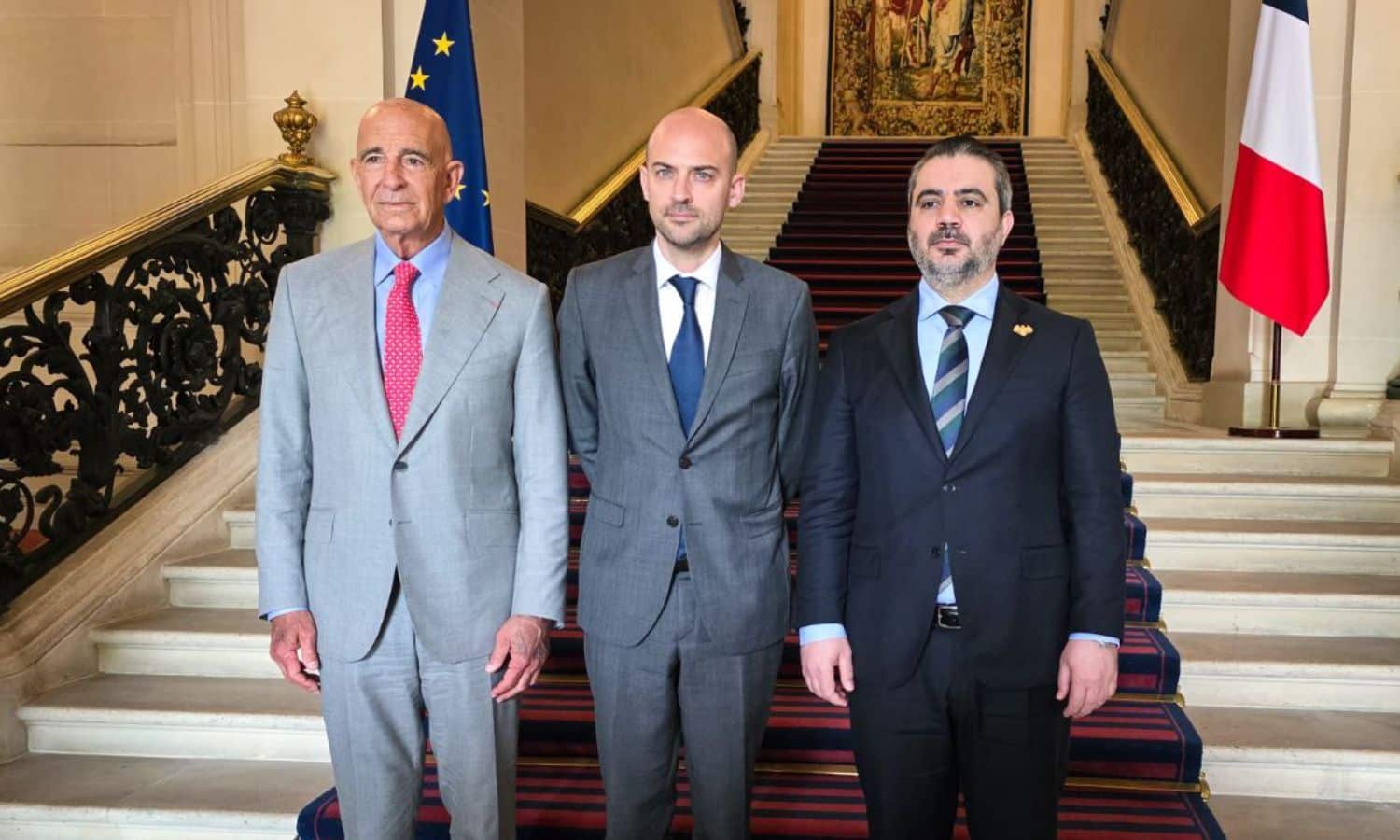
On 23 July, a meeting scheduled in France between representatives of the Autonomous Administration and the transitional government was postponed without explanation or a new date. Damascus announced on 25 July that the Syrian government would hold a round of consultations with the SDF in Paris as soon as possible, in a statement posted on X.
Nawar Shaban of the Harmoon Center believes moving the negotiations to Paris carries symbolic and political weight because France is one of the SDF’s main supporters. It also seeks to relocate the talks to an environment away from familiar regional pressures influenced by Turkey.
Louay Safi says the SDF’s proposal is unacceptable to the new administration because it risks gradually separating the north from the Syrian state—particularly since Kurds in northern Syria, unlike those in northern Iraq, live in areas with Arab majorities and their villages are dispersed and non‑contiguous.
Safi argues the Syrian government should allow citizens from all provinces to take part in running their regions within a unified central state by adopting a local‑administration system that lets residents of all Syrian areas and cities elect municipal and provincial councils and manage their police institutions, while the centre retains security, economic and foreign‑policy decisions.
Maen Tallaa, research director at the Omran Center for Strategic Studies, says the issue is not whether the SDF should be ended but how the Syrian state can regain control over all Syrian territory without excluding other parties. Thus, he says, discussions in France or elsewhere will be driven by this positive thrust.
The SDF continues to pin its hopes on international or domestic shifts; what happened in Suwayda may motivate it, but in the end, that benefits neither the SDF nor Suwayda nor the central government
Maen Tallaa, director of research at the Omran Center for Strategic Studies.
Tallaa notes that the United States wants to foster an approach that guarantees regional stability, promotes development and ends hot spots in the region in line with its interests.
Speaking to Enab Baladi, he said the March agreement could be a starting point for four key areas: incorporating forces into the army, managing national resources and controlling borders, sharing power in the political arena and civic sphere.
Tallaa stresses that the central leadership in Syria should not monopolise all decisions and that relations among all parties should be governed by two principles: delegating powers between the center and the periphery, and creating a strong center with strong regional entities.
The post Paris negotiations run into “SDF” demands and Damascus’s refusal appeared first on Enab Baladi.