
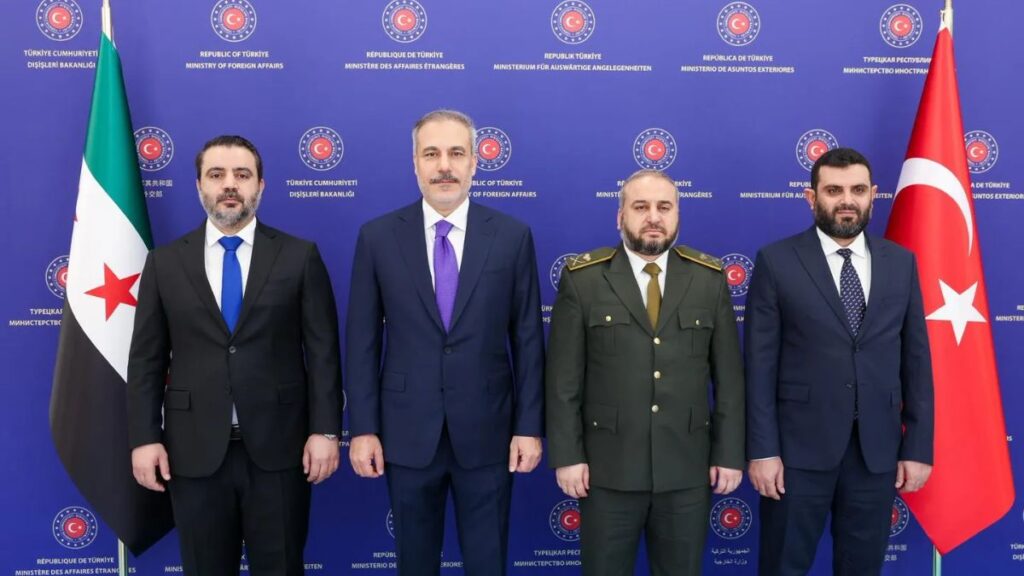
Damascus and Ankara are signaling a potential escalation over the “Syrian Democratic Forces” (SDF) in northeastern Syria, following stalled negotiations between Damascus and the forces.
On Wednesday, August 13, Syrian Foreign Minister Assad al-Shibani met his Turkish counterpart, Hakan Fidan, in Ankara, in the presence of Syrian Defense Minister Marhaf Abu Qasra and Intelligence Director Hussein Salameh.
The meeting addressed the course of the political process in Syria and security issues, most notably the activity of the Kurdistan Workers’ Party (PKK) and the SDF in northeastern Syria, as well as the field situation in As-Suwayda, according to Turkey’s Anadolu Agency.
During a joint press conference, Fidan stressed the need to “ensure that all residents of Syria feel equal” within the framework of a comprehensive political settlement. He emphasized that Ankara is closely monitoring the movements of the SDF, which he said continues to recruit fighters from outside Syria and maintains military readiness despite ongoing negotiations.
Fidan stated that PKK fighters from Turkey, Iraq, Iran, and Europe have not left Syria, and that there have been no positive developments either since the “March 10 Agreement” or during Turkey’s current peace process with the PKK, indicating that the group has not removed the threat of armed action.
He added that the SDF must stop stalling the integration process into the Syrian army and abide by the integration agreement with the Syrian government, according to Reuters.
The minister warned that failing to meet Turkey’s security demands in Syria makes “maintaining calm impossible,” calling on the SDF to stop “direct threats to Turkey and the region.”
For his part, Syrian Foreign Minister Assad al-Shibani said that the “Unity of Components” conference held in al-Hasakah does not represent the Syrian people and sought to exploit the events in As-Suwayda, describing it as a violation of the agreement to integrate the SDF into state institutions.
Al-Shibani affirmed that As-Suwayda is an integral part of Syria and its people are part of the social fabric of the Syrian nation.
He considered the events in As-Suwayda to be fabricated by Israel to stir internal division, affirming his government’s commitment to holding accountable all perpetrators of violations in As-Suwayda and elsewhere.
He added that Syria faces major economic and structural challenges after years of war, pointing to “ongoing Israeli threats that undermine Syrian sovereignty and pose a danger to its citizens.”
Al-Shibani warned against “attempts to divide the country along sectarian and ideological lines” and stressed his government’s commitment to working toward stability through dialogue with various components.
The SDF controls northeastern Syria and has been negotiating with the Syrian government, but talks have stalled since the “Components” conference.
“Unity of Components” Conference
The “Unified Position for the Components of Northeastern Syria” conference was held on August 8 at the Cultural Center in al-Hasakah, with the participation of over 400 political and religious figures, tribal elders from various Syrian regions, representatives of the Autonomous Administration, and the virtual participation of Sheikh Hikmat al-Hijri, spiritual leader of the Druze community, and Ghazal Ghazal, head of the “Supreme Alawite Islamic Council in Syria and the Diaspora.”
The conference concluded with a final statement in which participants agreed on a set of political and social principles and demands, focusing on the importance of pluralism, entrenching decentralization, and rejecting exclusion and marginalization.
The statement, published by Hawar News Agency (close to the SDF), called for drafting a new democratic constitution for Syria that enshrines decentralization, guarantees genuine political participation for all components, respects cultural and religious particularities, and strengthens values of social justice and freedom of belief.
It also stressed the need to review the current constitutional declaration, which participants said does not meet Syrians’ aspirations for dignity and freedom.
Participants expressed full support for the SDF, considering it a nucleus for building a new national, institutional, and professional army that protects the country’s borders and represents all its components.
The conference called for holding a comprehensive Syrian national conference that includes all democratic and national forces to outline a unified national identity and build a pluralistic, democratic, and decentralized Syria where human dignity is preserved and marginalized communities are recognized.
The March 10 Agreement
On March 10, transitional Syrian President Ahmad al-Sharaa and the SDF’s Commander Mazloum Abdi reached an agreement to integrate the SDF into Syrian state institutions.
The agreement guarantees the rights of all Syrians to representation and participation in the political process and all state institutions based on competence, regardless of religious or ethnic background.
According to the terms, the Kurdish community is recognized as an integral part of the Syrian state, with the state guaranteeing its citizenship and constitutional rights.
The agreement also included a nationwide ceasefire and the integration of civilian and military institutions in northeastern Syria into the Syrian state administration, including border crossings and oil and gas fields.
Al-Sharaa and Mazloum Abdi also agreed to ensure the return of all displaced Syrians to their towns and villages, guaranteeing their protection by the Syrian state, in addition to supporting the Syrian state in combating the remnants of Assad and all threats to its security and unity.
The post Damascus and Ankara Threaten Escalation in Eastern Syria appeared first on Enab Baladi.