

Amir Hakouk| Rakan al-Khadr | Wasim al-Adawi
Since the July 2025 events, Suwayda (southern Syria) has become more than a scene of transient security tension. It has turned into a complex model reflecting deeper shifts in the structure of the Syrian state and its relationship with outlying regions. Events that began as local clashes quickly exposed a wider crisis that went beyond the on-the-ground dimension, raising core questions over legitimacy, representation, the limits of authority, and the role of local and regional actors.
In this context, the crisis is no longer confined to its political dimension. It has expanded to legal and living conditions, as debates over the shape of administration and the future relationship with the state have overlapped with a clear deterioration in services and the economic reality facing residents.
Enab Baladi, in this file, seeks to unpack the scene in Suwayda through three parallel tracks.
The first track is political, highlighting shifts in power and representation and the struggle over legitimacy. The second is legal, discussing the question of self-determination in the face of the principle of state unity. The third addresses the impact on services and livelihoods, which directly affects residents’ daily lives.
A Complex Political Map
Legitimacy Struggles and Stalled Paths
Suwayda city witnessed rapid transformations over the past year, moving from relative stability into an open space of overlapping political, security, and social crises. The events that erupted in July 2025 marked a turning point that redrew the relationship between the local community and the state and exposed deep fractures in the structure of authority and representation inside the city.
These transformations intersected with internal factors linked to the structure of the local community and its religious and social authorities, as well as external factors tied to regional and international balances. This made Suwayda an arena for multiple pulls that extend beyond its geographic borders.

A demonstration in al-Karama Square in Suwayda demanding the right to self-determination, April 11, 2026. (Enab Baladi)
Suwayda Events
The Suwayda events began on July 12, 2025, after reciprocal kidnappings between residents of al-Maqwas neighborhood in Suwayda, which has a Bedouin majority, and a number of members of the Druze community. The incidents developed the next day into mutual clashes.
The Syrian government intervened on July 14 to break up the dispute, but its intervention was accompanied by violations against Druze civilians. This pushed local factions to respond, including factions that had been cooperating with the Ministries of Defense and Interior.
On July 16, government forces left Suwayda after being targeted by Israeli strikes. This was followed by violations and retaliatory acts against Bedouin residents in the governorate, which led to the dispatch of military convoys in the form of tribal mobilizations in support of Bedouin residents.
A Breakdown in Trust
The transformations that followed the July events, as a decisive moment that changed the nature of balances inside the city, were no longer limited to security repercussions. They extended to the nature of the relationship between the local community and the state, the limits of political legitimacy, and concepts of belonging and representation.
Senior researcher at the Arab Center for Contemporary Syria Studies Dr. Samir al-Abdullah believes that the situation before the July events could be described as one of “controlled tension,” in which rejection of centralized policies prevailed alongside a clear insistence on remaining within the framework of the state. There was also theoretical room for a political settlement based on expanding decentralization and providing security and administrative guarantees.
But the July events marked a collapse in the level of trust, as the local community in Suwayda shifted its view of the state from a guarantor to an entity seen as incapable or complicit. This led to a reformulation of the state’s place in local consciousness and pushed some groups to think about more independent forms of administration or alternatives that go beyond the existing model, al-Abdullah told Enab Baladi.
“The July events marked a collapse in the level of trust, as the local community’s view of the state shifted from a guarantor to a complicit party.”
Samir al-Abdullah
Senior researcher at the Arab Center for Contemporary Syria Studies
By contrast, the media spokesperson for the Third Current in Suwayda, Kenan Masoud, said the pre-events phase saw a clear attachment to the concept of one Syrian state and rejection of any separatist projects, with strong slogans affirming the country’s unity and rejecting Israel.
After the July events, however, Masoud told Enab Baladi that the scene witnessed a deep psychological and political shift, represented by a reevaluation of the concepts of homeland, enemy, and friend, along with the rise of inciting sectarian discourse. This contributed to deepening the shock within society, widening the gap with other Syrian components, and creating anxiety and uncertainty about the future.
Internal Moves to Absorb Street Anger
Suwayda city witnessed attempts to reshape the administrative structure. Residents of the city also held a protest in al-Karama Square on April 5, demanding the resignation of the High Legal Committee, before it was dissolved, against the backdrop of deteriorating economic and living conditions.
Afterward, the spiritual leader of the Druze community, Hikmat al-Hijri, announced the dissolution of the High Legal Committee and the formation of the Administration Council in Jabal Bashan.
Here, senior researcher at the Arab Center for Contemporary Syria Studies Dr. Samir al-Abdullah believes that Suwayda is currently living in a state of de facto decentralization, but one that lacks stability and institutionalization. The state remains partially present, while local leaders, foremost among them Hikmat al-Hijri, have emerged as authorities managing the scene without possessing integrated tools of governance. This has created overlap among local actors, including factions and civil initiatives, in an environment that lacks a clear governance structure.
In this context, al-Hijri’s decision to dissolve the “Judicial Committee” and form a “crisis management council” can be understood as a step aimed at absorbing public anger and reorganizing the internal scene, more than as a radical shift in the structure of local authority. The decision came under street pressure, but it also reflects an attempt to preserve existing balances and consolidate the leadership’s position during an extremely sensitive phase.
Kenan Masoud, the media spokesperson for the Third Current in Suwayda, considered al-Hijri’s recent changes no more than a formal change intended to hold specific parties responsible for the abuses that occurred, including attacks on official institutions such as the Education Directorate and the resulting threat to students’ futures, especially 2025 baccalaureate students.
He stressed that these steps were not accompanied by the granting of real powers, but instead reproduced the same names.
Government Silence, Avoiding Escalation?
The absence of clear official positions from the Syrian government toward what is happening in Suwayda raises questions about the nature of this silence and its political implications.
Researcher Samir al-Abdullah considers the silence to reflect a mix of caution, a desire to avoid escalation, and regional calculations. At the same time, however, it worsens the crisis of trust and leaves a political vacuum.
As for Third Current spokesperson Kenan Masoud, he believes the silence is linked to political considerations, including avoiding escalation of foreign interventions and preparing conditions for understandings that may lead to a solution satisfying various parties.
The Third Current, Under Debate
What is known as the Third Current has emerged as an attempt to present a centrist approach, but its presence and influence in the scene remain under debate.
The Third Current is an initiative that announced a roadmap aimed at protecting society and preventing a slide into chaos through the creation of the Civil Rescue Authority in Suwayda, a civilian body.
The Current’s spokesperson, Kenan Masoud, said the Third Current presented a practical project to transform the state of deadlock into clear, time-bound demands, including education and student issues, especially those of students who were unable to sit for their exams at Syrian universities.
He noted that the Current has a broad popular base, but lacks armed power amid a monopoly over decision-making by armed parties. This limits its ability to move, especially with signs of security restrictions against its activists.
Researcher Samir al-Abdullah said that what is known as the Third Current tried to propose a centrist approach combining remaining within the state with rejecting full submission. But its influence remained limited because of weak organization and the absence of executive tools. In an environment dominated by polarization, such proposals appear closer to intellectual projects than to applicable political alternatives.
A Roadmap That Has Yet to See the Light
The Syrian Ministry of Foreign Affairs and Expatriates announced on September 16, 2025, that a Syrian, Jordanian, and American roadmap had been reached to resolve the crisis in Suwayda governorate.
The roadmap stipulated a set of urgent measures, most notably:
- The Syrian government inviting the Independent International Commission of Inquiry to investigate the events witnessed by Suwayda.
- Holding all perpetrators of violations accountable under Syrian law.
- Continuing the entry of humanitarian and medical aid into the governorate.
- Deploying qualified police forces on the Suwayda, Damascus road to secure the movement of citizens and trade.
Despite this initiative to resolve the crisis, it has not achieved tangible results so far, raising questions about the reasons for its failure.
Senior researcher at the Arab Center for Contemporary Syria Studies Dr. Samir al-Abdullah believes that the roadmap proposed with the participation of regional and international parties also failed to create a breakthrough because it focused on security and service aspects and ignored the essence of the crisis, the loss of trust. The absence of a unified local partner also weakened the chances of implementing it on the ground.
The Third Current spokesperson, meanwhile, stressed that the roadmap announced with the participation of Syria, Jordan, and the United States still forms the basis for any solution, despite slow implementation due to political circumstances.
External Presence for Specific Interests
In parallel with the internal complexities witnessed by Suwayda, the external factor is increasingly present as an influential element in the course of events and the balance of the scene in southern Syria.
Here, researcher Dr. Samir al-Abdullah explains the growing influence of the external factor in southern Syria, where Jordanian and US interests intersect over border stability, while Israel emerges as a direct player under the banner of “protecting the Druze,” within calculations that go beyond the humanitarian dimension to security and strategic considerations.
He believes that, amid this scene, Suwayda faces two choices, either continuing in the current state of political suspension, with all the internal depletion it carries, or moving toward a realistic settlement path. Yet no settlement will be possible without addressing the deep roots of the crisis, foremost among them restoring trust, providing genuine guarantees, and building a local administration model that ensures residents’ real participation.
In al-Abdullah’s view, the solution does not lie in any party imposing facts on the ground, but in reaching a gradual and realistic settlement based on negotiation among the different parties, with the aim of reaching a formula that ensures the minimum level of stability, prevents a slide into chaos, and maintains the continuity of basic services.
The Third Current spokesperson, however, considers that events in the south provided a pretext for foreign interventions, especially by Israel, which, according to him, seeks to exploit the situation to achieve goals related to establishing separate entities or zones of influence inside Syria.
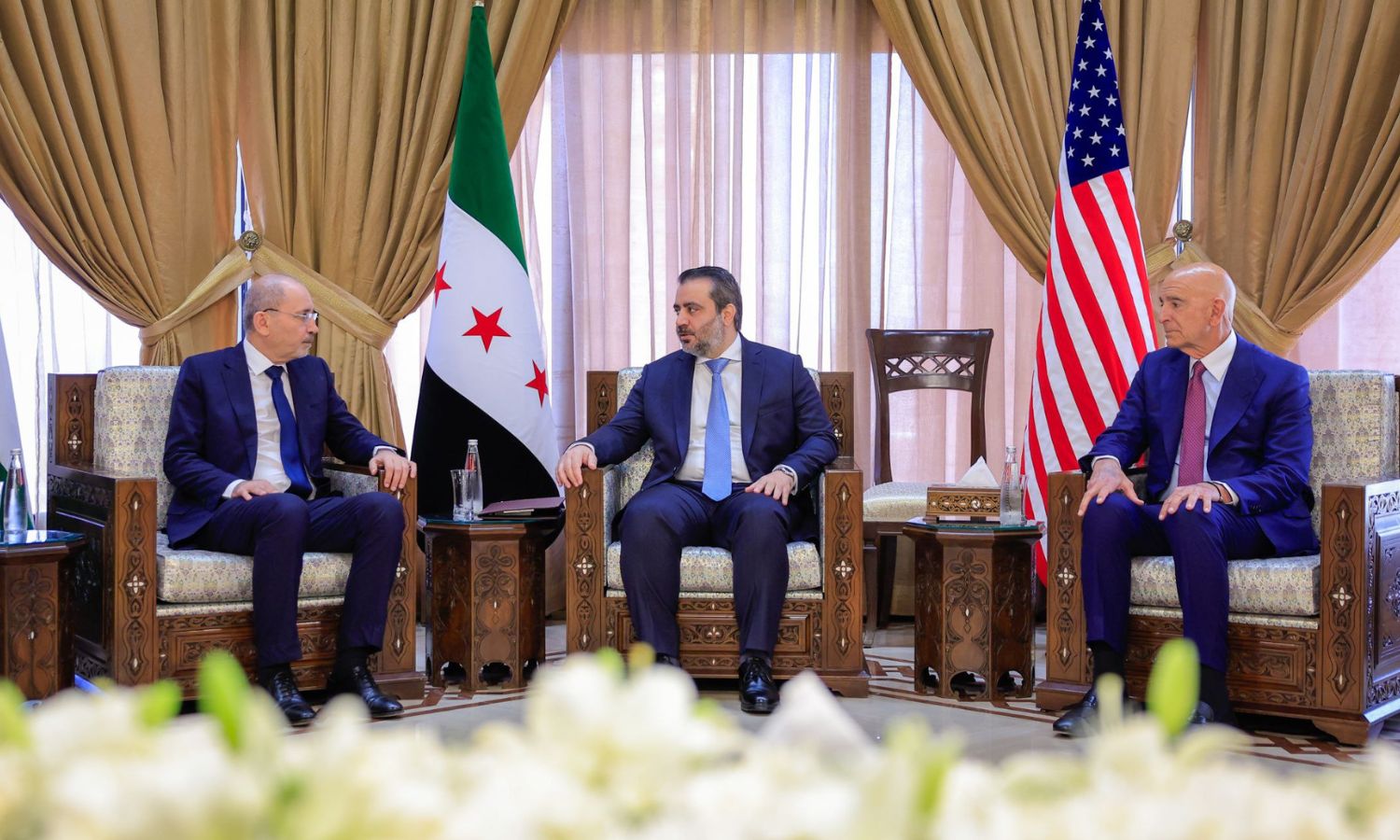
Syrian Foreign Minister Asaad al-Shibani meets his Jordanian counterpart Ayman al-Safadi and US envoy to Syria Thomas Barrack, September 16, 2025. (Syrian Foreign Ministry)
Legal Challenges
The Right to Self-Determination Versus Syria’s Territorial Integrity
Amid political complexity and the struggle over legitimacy, some proposals inside Suwayda have begun to raise more fundamental questions. These do not relate only to the form of administration, but to the nature of the relationship with the state itself, opening the door to a legal debate over concepts such as autonomy and self-determination.
In the context of discussing demands by some residents of Suwayda for independence or autonomy, Syrian rights advocate Fadel Abdulghany explained that “self-determination” is one of the most complex and controversial principles of international law, because it intersects with the principles of state sovereignty and territorial integrity, two basic pillars of the international order.
Abdulghany noted that this contradiction places the international community before a difficult equation between recognizing peoples’ right to choose their political future and, at the same time, preserving border stability and preventing the breakup of states.
The rights advocate said the idea of self-determination historically moved from a political proposal advanced by Woodrow Wilson to a legal principle in the United Nations Charter. But it remained governed by a delicate balance between peoples’ aspirations for independence and the requirements of international stability, making it subject to an equation in which politics and law overlap. It is theoretically recognized as a fundamental right, but in practice restricted by the priority of territorial integrity when it conflicts with separatist demands.
He also noted that Article 1 (2) of the UN Charter, which provided for peoples’ right to self-determination, came in an inconclusive formulation that reflected the balance of power between colonial states and emerging states at the time.
With the 1966 international covenants, the International Covenant on Civil and Political Rights and the International Covenant on Economic, Social and Cultural Rights, self-determination became a clearer universal right, granting peoples the right to determine their political status and development. Yet its practical application remained subject to complex political and legal considerations.
Article 1 (2) of the United Nations Charter:
Equal rights and the right of peoples to self-determination. Article 1 (2) states that among the basic purposes of the United Nations, and therefore of the Security Council, is to develop friendly international relations based on respect for the principle of equal rights and the right of peoples to determine their own destiny.
Ideas Between Autonomy and Separation
Rights advocate Abdulghany noted that the right to self-determination has multiple forms, but under strict limitations.
In some circles inside Suwayda, ideas are being raised that range between “autonomy” and “full separation,” which also leads to distinguishing between two types of self-determination, internal and external.
International law has developed several forms of self-determination, most notably:
- External self-determination, leading to independence, which is the most sensitive and the most restricted.
- Internal self-determination, achieved through autonomy and democracy within the state, which is the most internationally accepted form.
The Syrian rights advocate stressed that in the case of Suwayda governorate, all forms of self-determination face strict ceilings imposed by state sovereignty and territorial integrity.
Article 2 (4) of the United Nations Charter prohibits the use of force against the unity of states, creating a legal obstacle before separatist movements.
The 1970 Friendly Relations Declaration reinforced this direction, as Abdulghany stressed that self-determination may not be used to dismantle states except in exceptional cases, such as colonialism, occupation, or racist regimes.
Decisions Governed by Politics, Not Law
International experiences show that demands for self-determination are not all treated in the same way. This applies to the case of Suwayda, as the international community does not rely only on law, but is also significantly influenced by politics and interests.
Rights advocate Abdulghany said, “There are no clear or unified standards for evaluating self-determination demands, which makes its application selective and subject to political calculations. While internal self-determination enjoys broad acceptance, external self-determination faces strict restrictions.”
In colonial cases, the right to independence was almost absolute, as in the 1960 Declaration, but outside this context the matter becomes more complex.
What Is the 1960 Declaration?
It is a historic resolution adopted by the United Nations General Assembly, also known as Resolution 1514, and is considered one of the most important documents that established the principle of decolonization in international law.
The declaration stated that all peoples have the right to self-determination, and that colonialism constitutes a denial of this right and a violation of fundamental human rights. It also called for transferring power to colonized peoples without conditions or delay, ensuring their freedom and full independence.

A demonstration in al-Karama Square in Suwayda demanding the right to self-determination, April 11, 2026. (Enab Baladi)
International Respect for Constitutions That Ban Separation
Rights advocate Abdulghany said the Syrian constitution, like many constitutions, does not permit separation, which strengthens the international position rejecting Suwayda’s separation from Syria. This difficulty increases with the absence of a clear definition of the concept of “the people,” opening the door to questioning any demand for independence.
Economic and security concerns also play a role in rejecting the demands of some Suwayda residents, out of fear that the separatist contagion could spread to other areas.
Abdulghany added that international rejection of self-determination demands is often the result of the overlap between law and politics. The principle of territorial integrity creates a strong presumption against recognizing separation, limiting this right to rare cases.
Geopolitical calculations greatly influence recognition decisions, as the interests of major powers determine the outcomes of cases more than legal rules do. Many national constitutions also ban separation, which is respected under international law, according to Abdulghany.
In 1998, Canada’s Supreme Court issued an advisory opinion in the case of Quebec’s secession, addressing a central question about whether the province had the right to unilaterally secede from Canada under international law or the Canadian constitution.
The court concluded that unilateral secession does not rest on a direct legal right, but it may impose an obligation on the federal government to enter negotiations if there is clear popular support and clear democratic legitimacy. It also stressed that any change in constitutional status must take place within a negotiated framework that respects the rule of law and the constitution.
Envoy Barrack Seeks a Solution to the Crisis in Suwayda
American Syrian lawyer Samir Sabounji, who is close to circles in the US Congress, told Enab Baladi that there are members of Congress who believe diplomacy is capable of resolving the crisis in Suwayda. He revealed that information circulating in the corridors of Congress indicates that the US special envoy to Syria is seeking to resolve the Suwayda issue, and that there is a belief a solution will be reached soon.
“Many members of the US Congress know how difficult the Suwayda issue is, and what worsens the problem is that Israel is playing a role that is not constructive in this governorate and in Syria in general.”
Samir Sabounji
American Syrian lawyer
The Legal Basis for the Right to Self-Determination
Lawyer Samir Sabounji believes that international law does not grant the right to self-determination to regions inside independent states. Rather, it is mainly linked to contexts of liberation from colonialism and occupation, as happened in historical cases such as Algeria’s independence and the independence of a number of African states.
He said international law tends to prioritize the principle of the territorial unity of sovereign states, meaning there is no legal basis for the separation of regions within them, except in exceptional cases linked to serious and continuing violations.
In the Syrian case, Sabounji noted that what happened in July 2025 was not classified as a case of continuing violations, especially with the formation of local and international investigation committees. This makes separation demands, according to this interpretation, unsupported by international legal grounds.
International Caution Over Supporting Separatist Movements
Lawyer Samir Sabounji noted that states usually tend to be cautious in supporting separatist movements, fearing this could create a precedent that might reflect on their own internal stability.
He said some cases, such as Kosovo, were linked to exceptional circumstances related to Serbia’s independence, the presence of overwhelming majority voices in Kosovo calling for independence, and a context of large-scale massacres.
Sabounji stressed that the principle of “territorial integrity” is one of the basic pillars of international law. It requires respect for the recognized borders of states and prevents their alteration by force or through unilateral decisions. This principle is enshrined in the United Nations Charter to ensure the stability of the international order.
In the Syrian case, he believes this principle favors the unity of the state as a sovereign state and a member of the international community. This makes any separatist orientation weak in its international legal basis, unless linked to serious and continuing violations.
International Recognition as a Decisive Factor
International recognition constitutes a decisive element in any separatist project, but it is often limited in cases involving regions inside independent states. Such cases rarely enjoy broad international support, according to lawyer Sabounji.
Regarding Suwayda, he noted that even if any independent entity were declared, the absence of international recognition would make this path impossible to consolidate in practice, given the international system’s reliance on the positions of other states.
He concluded that the general trend in the international community leans toward supporting states’ internal stability and seeking political solutions that guarantee equality and rights within one state, rather than supporting separation projects that do not enjoy broad international cover.
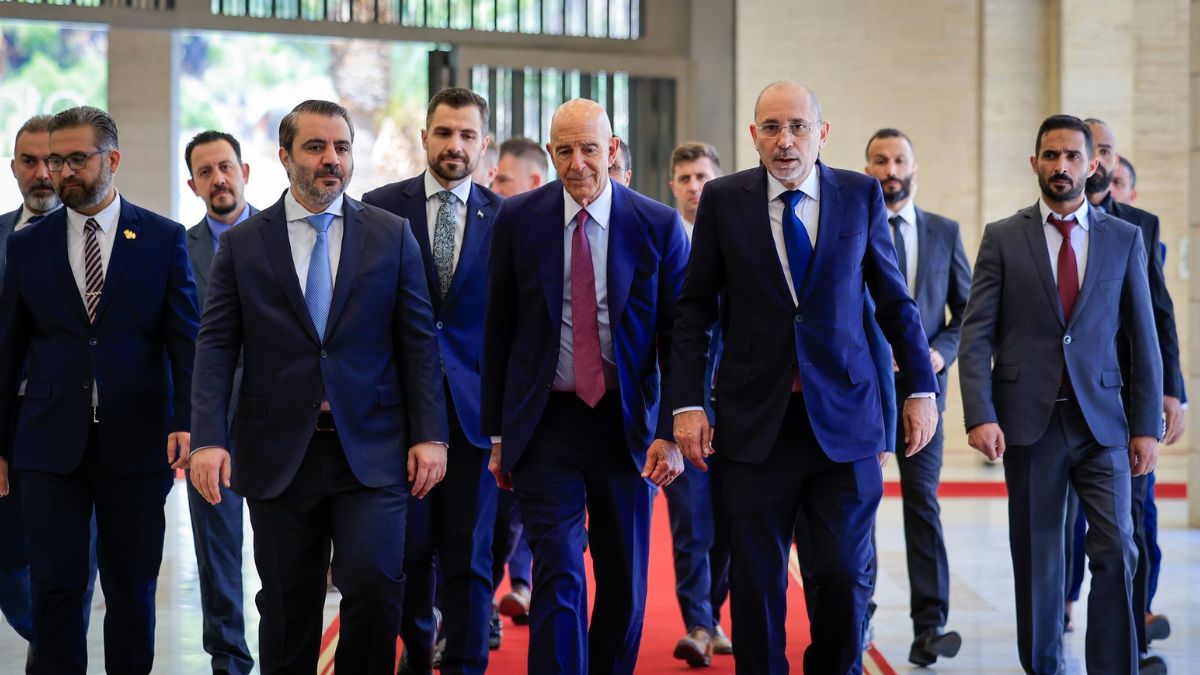
Syrian Foreign Minister Asaad al-Shibani meets his Jordanian counterpart Ayman al-Safadi and US envoy to Syria Thomas Barrack, September 16, 2025. (Syrian Foreign Ministry, X)
Livelihood Crisis and Disrupted Services and Education
Suwayda governorate is witnessing a rapid deterioration in living and service conditions, directly affecting residents’ daily lives, amid a continued rise in the prices of basic goods, declining purchasing power, delayed salary payments, and the repercussions of the security and political unrest the governorate has witnessed in the recent period.
Between relative abundance in markets on one hand and citizens’ growing inability to secure their needs on the other, the living crisis is deepening to become one of the most prominent repercussions of the broader scene in the area.
Rising Prices and Declining Purchasing Power
Despite the availability of basic food items in Suwayda’s markets, a number of residents confirmed to Enab Baladi that the main problem lies in the sharp rise in prices compared with income levels. They noted that goods are generally available, but the ability to buy them has become very limited among a wide segment of residents, amid weak salaries and rising living costs.
One resident said, “Goods are available, but citizens are sometimes unable to buy them because of high prices and weak salaries.” Another said vegetable and meat prices had risen sharply, making securing daily needs an increasing burden.
The crisis is not limited to food. Residents point to shortages of electrical equipment and building materials, which has disrupted some freelance professions and reduced local economic activity.
Unavailable items include lighting batteries, solar panels, and some household necessities, amid complaints about difficulties bringing goods in through roads and checkpoints.
Some residents also spoke of obstacles related to the movement of goods, while traders justify the sharp increase in prices by pointing to the rise in the US dollar exchange rate, transport difficulties, and higher import costs. Others believe restrictions imposed on commercial movement contribute to deepening the crisis inside the governorate.
Delayed Salaries and Growing Living Pressures
Alongside high prices, employees in Suwayda face a worsening crisis related to delayed salary payments, increasing living pressure on thousands of families.
One worker in the services sector, an employee at the city council, said he had not received his salary for about three months, forcing him to rely on borrowing and help from relatives to secure his basic needs.
In another case, a retired female employee said she had not received her salary since July 2025, explaining that the payment mechanism had changed and was now handled from Damascus rather than from inside the governorate. This forced her to search for alternative solutions such as authorization or money transfers, as she was unable to travel for health and security reasons.
To deal with these conditions, some residents authorize relatives in Damascus to receive their salaries or use money transfer services, while others face difficulties related to lengthy procedures or overcrowding at payment centers.
Still, some residents said they had been able to receive their salaries from centers inside the governorate, with relative organization in some places, despite suffering linked to long waits.

Protesters in al-Karama Square in Suwayda city during a sit-in supporting al-Hijri and demanding self-determination, April 11, 2026. (Enab Baladi)
Salaries That Do Not Cover the Minimum
Even in cases where salaries are paid, employees believe they are no longer enough to cover the minimum needs. A nurse at Suwayda National Hospital said the salary runs out during the first days after receiving it because of high prices and accumulated debts. She noted that any salary increase is met by a parallel rise in prices, stripping it of its real value.
She added that there is disruption in payment schedules, especially in the health sector, where salaries are sometimes paid irregularly or after several months, increasing the difficulty of managing daily expenses.
A number of substitute teachers carried out a strike to protest delayed financial dues, demanding a clear and regular mechanism for salary payments that would ensure living stability for educational staff.
Diverging Explanations of the Living Crisis
Residents’ views differ over the causes of the living crisis in Suwayda. While some believe security and political conditions play the main role, others think the problem is linked to mechanisms for bringing in goods and paying salaries, in addition to restrictions on commercial movement. A third group attributes the crisis to the general economic deterioration and the rise of the dollar against the Syrian pound.
Despite differing explanations, most residents agree on a set of basic demands, foremost among them regular salary payments on time, easier access to salaries, and ensuring the availability of basic goods without obstacles and at prices suitable for purchasing power.
A Continuing Education Crisis
The impact of the crisis has not been limited to living conditions. It has extended to the education sector, which witnessed widespread disruption after the July 2025 events, as the educational process stopped in a number of schools after they were turned into hosting centers.
Secondary school students were among the most affected, as their exams were delayed compared with the rest of the governorates before compensatory exams were later held separately. But the announcement of results did not end the state of anxiety, as many students are still awaiting official recognition of their certificates.
Students express fears over their academic future amid unclear decisions. One female student said tensions at the Education Directorate “increased the state of confusion,” while other students question the fate of their cohorts and fear losing academic years if the certificates are not officially recognized.
Government Denies Obstacles Exist
For his part, Suwayda Governorate Public Relations Director Qutaiba Azzam attributed the rise in the prices of basic goods to what he described as “exploitation of the state of chaos and absence of law” in some areas outside state control.
Azzam stressed that the Syrian government does not prevent the entry of food or basic goods into the governorate, noting that goods are brought in normally with official facilitation, and denied the existence of any ban on electrical materials or other goods.
He also explained that inspection operations at checkpoints aim to prevent weapons and drug smuggling, in addition to checking vehicle papers, amid what he described as the spread of thefts in some areas.
Regarding salaries, Azzam noted that some complications are due to the loss of part of the financial block allocated to employees as a result of armed groups taking control of financial institutions, which affected the payment mechanism inside the governorate.
He added that salaries are paid from specific centers according to regular schedules, with the continued entry of food, flour, and fuel into Suwayda, stressing that “the state is carrying out its duty toward citizens.”
“The Syrian government does not prevent the entry of food or basic goods into the governorate. The state is carrying out its duty toward citizens.”
Qutaiba Azzam
Public Relations Director in Suwayda Governorate
The post Suwayda After July 2025: Legitimacy Struggles and Livelihood Crisis appeared first on Enab Baladi.